
Hua Hin Travel Guide · Chapter 5 of 8
Temples, Palaces and Viewpoints Around Hua Hin
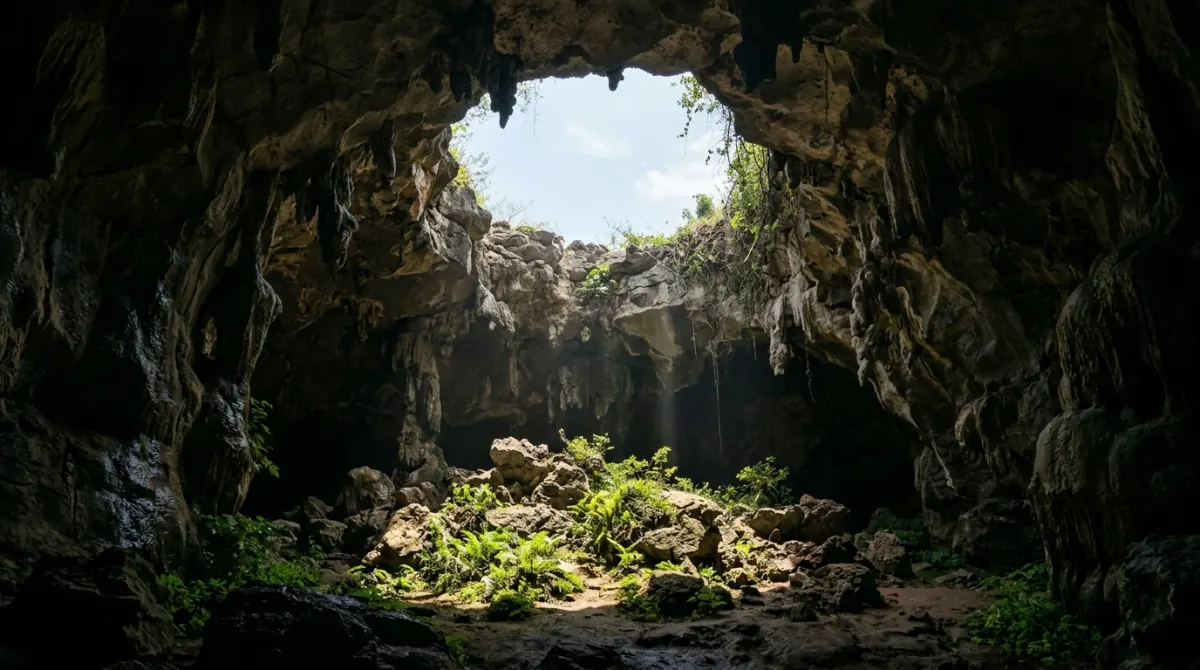
Phraya Nakhon Cave is the one sight worth rearranging a day around — a royal pavilion inside a collapsed cave, lit by a shaft of sun between roughly 10:00 and 11:30 and ordinary once it moves. Everything else here, from Wat Huay Mongkol to the teak palace at Maruekhathaiyawan, is an easy hour or two.
At a glance
| Place | From central Hua Hin | Cost | Open | Time needed |
|---|---|---|---|---|
| Phraya Nakhon Cave, Khao Sam Roi Yot | 60–63 km south, 45–60 min | Park fee 200 THB (approx. USD 6) foreign adult, 100 THB (approx. USD 3) child; boat extra | Daily from 08:00; closing time disputed | Half a day |
| Wat Huay Mongkol | 15–18 km west, 20–30 min | Free, donations | Daily, daylight hours | 1 hour |
| Khao Takiab temple hill | 6–7 km south, 10–15 min | Free, donations | Sunrise to sunset | 1–2 hours |
| Maruekhathaiyawan Palace | About 15 km north, 20 min | 90 THB (approx. USD 2.70) adult, Thai and foreign alike | Friday–Sunday 09:00–17:00 | 1–1.5 hours |
| Wat Khao Krailat | Nong Kae, near Khao Takiab | Free | Daily, daylight hours | 45 min |
| Wat Tham Khao Tao | 15–20 min south | Free | Daily, daylight hours | 45 min |
| Khao Hin Lek Fai viewpoint | Short drive west of town | Free | Daylight; no confirmed gate hours | 30 min |
| Monsoon Valley vineyard viewpoint | West of town, inland | Distance, drive and prices in Chapter 6 | Daily | Half a day |
Phraya Nakhon Cave: timing the trip around the light
This is the sight that justifies the drive south. Phraya Nakhon is a cave inside Khao Sam Roi Yot National Park whose roof has collapsed in two places, opening the chambers to the sky. Standing on the floor of the larger sinkhole is the Kuha Karuhas pavilion: a small four-gabled royal pavilion built in Bangkok during the reign of King Rama V, dismantled, carried down the coast and reassembled inside the cave, with its completion ceremony in 1890. Rama V's signature and that of Rama VII are cut into the rock beside it. Late in the morning a column of sunlight drops through the collapsed roof and lands on the pavilion. That is the photograph, and it is the entire reason to go at the hour you go.
Getting there has three stages, and each one takes longer than people expect.
Stage one — the drive. The trailhead is Bang Pu village, 60–63 km south of Hua Hin, 45 minutes to just over an hour by road. Park entry is 200 THB for foreign adults and 100 THB for foreign children, against 40 and 20 THB for Thai nationals. The ticket is valid all day at every park entrance, so it also covers the Khao Daeng viewpoint and the freshwater marsh if you want to make a full day of the park. Both the fees and that all-entrances rule come from travel sources rather than from the Department of National Parks, so keep the stub and check at the second gate before you rely on it.
Stage two — getting round the headland. From Bang Pu you either take a longtail boat to Laem Sala Beach, 10–15 minutes, or walk over the headland on a steep 500 m path that takes about 30 minutes. Boat pricing is quoted two different ways by reputable sources and we could not establish which is current: roughly 400 THB (approx. USD 12) for the whole boat carrying six to eight people, or roughly 150 THB (approx. USD 4.50) per person return. Carry enough cash for the higher figure and settle the price at the pier before you get in. One long-standing source also notes that the boats generally leave when there are enough passengers to fill them, which is a real consideration at 09:00 on a quiet weekday — if you are on a schedule, expect either a wait or a charter price for the empty seats.
Stage three — the climb. From Laem Sala Beach the trail to the cave is 430 m long and climbs about 130 m on steep, uneven stone steps with rope-assisted sections. Allow 30 minutes going up in humid heat. There is a viewpoint roughly halfway that most people use as a breather. This is not a stroll and it is not suitable in flip-flops — the descent is where people fall. From May to November the steps are slick with rain and moss.
Put together, that is roughly 45 minutes each way from Bang Pu by boat, or an hour each way on foot. A realistic timeline for the light:
| Time | Where |
|---|---|
| 07:30 | Leave Hua Hin (08:00 is the latest that works) |
| 08:45–09:00 | Arrive Bang Pu, pay park fee, arrange boat |
| 09:15 | Boat to Laem Sala Beach |
| 09:30–10:00 | Climb to the cave |
| 10:00–11:30 | In the cave for the light |
| 12:15 | Back at Bang Pu |
| 13:15 | Back in Hua Hin |
About six hours door to door, and that assumes nothing goes slowly. On the light window itself, credible sources split between 10:00–11:00 and 10:30–11:30, and no official park statement of an exact hour was retrievable. Being inside the cave from 10:00 and staying until 11:30 covers both. The beam is strongest from November to May, with park officials naming the stretch up to the end of January as the best because the sun angle holds the light on the pavilion longer. On a cloudy day there is no beam at all. That is the single biggest reason people come away disappointed — the cave is worth seeing regardless, but the photograph depends on the weather and nobody can promise it.
Closing time is genuinely unclear: 15:30, 16:00 and 16:30 are all published by sources that are otherwise reliable, and one national-park database gives the park day as 08:00–16:00. Treat 15:00 as the last realistic moment to start the climb, and do not plan a late-afternoon visit around any of those figures.
Being in the cave at 10:00 means leaving Hua Hin around half past seven, and that early departure is the one thing a private car changes about this trip — no shuttle or scheduled service leaves town early enough.
Wat Huay Mongkol and the Luang Por Thuad statue
Wat Huay Mongkol came after the statue rather than before it, and knowing that sets the right expectation. The statue is a colossal figure of Luang Por Thuad, a revered southern monk whose amulets are among the most collected in Thailand, seated on a three-tier mound. It is cited at 11.5 to 12 m tall and about 10 m across the lap, on a ground-floor base roughly 70 m square, and is described locally as the largest of its kind anywhere.
At the four corners of the base stand wooden three-headed Erawan elephants; visitors walk beneath them and rub the belly for luck. The grounds also hold an equestrian statue of King Taksin, a venerated fallen teak tree, a small ordination hall, an artificial waterfall, a lake with bridges and pavilions, rows of amulet and souvenir stalls, Thai food stalls and a basic cafe. In January the sunflower fields nearby come into bloom and the site gets busier again.
It is 15–18 km west of town via route 3218, 20–30 minutes' drive. Entry is free and the site runs on the donation boxes scattered through the grounds. Weekends bring Thai pilgrims in numbers and the amulet trade at full volume; weekdays are quieter and easier to walk. There is very little shade anywhere on the site.
Published opening hours are unreliable here. Three different ranges are in circulation — 05:00–22:00, 06:00–18:00 and 08:00–18:00 — and no temple source could be reached to settle it. It is a working temple with open grounds, so daylight hours are safe, but do not plan a dawn or after-dark arrival on the strength of any figure you read online.
If you are looking for age and atmosphere, this is not the place — it is a large modern site in concrete and gold. If you want scale, and the sight of Thai devotional practice happening at full tilt, it delivers both in about an hour.
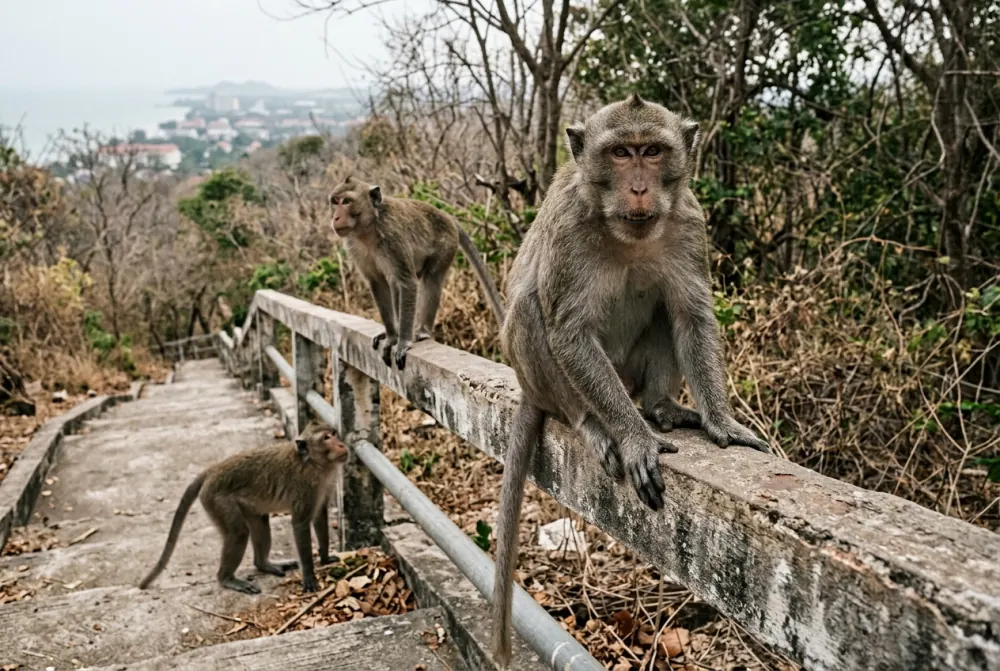
The macaques at Khao Takiab bite, and they go for bags before they go for people
Khao Takiab is the 272 m headland 6–7 km south of town, ten to fifteen minutes by road, closing the southern end of the bay. The landmark you can see from Hua Hin beach is the large standing Buddha at the foot of the hill, reported at around 20 m, facing out to sea from the rock where the sand ends. The temple complex sits on top: a Thai-Chinese hilltop temple with pagodas, a Guanyin statue, a laughing Buddha and shrines finished in mother-of-pearl inlay, and the best free coastal view in the immediate area. Listings use two names for the hilltop temple interchangeably, Wat Khao Takiab and Wat Khao Lad, which makes searching for it confusing.
Entry is free, with donation boxes only, and there is nothing to book. You reach the top either on several hundred steep, worn concrete steps or up the road by car, tuk-tuk or motorbike. Allow about two hours for the base, the climb and the summit. The outdoor viewpoints stay reachable through the day; the inner shrines close earlier.
The complication is the resident troop of long-tailed macaques, and it is a real one rather than a colourful detail. Documented visitor incidents include bags torn open, water bottles taken, food snatched out of hands, sunglasses and hats swiped, and monkeys occupying parked scooters and refusing to move. They bite. Local residents report theft from homes, and in 2021 a troop was seen crossing walls and power cables down into Hua Hin town to forage.
Authorities have acted, without solving it. In January 2024 the Minister of Natural Resources and Environment ordered accelerated control of the Hua Hin macaques — capture, sterilisation and relocation to wildlife facilities — after the population outgrew its food supply and turned more aggressive. In November 2024 the Department of National Parks reported relocating 203 animals, 109 male and 94 female, from Khao Takiab, Khao Hin Lek Fai and Khao Pitak to the Huai Sai breeding centre at Cha-Am, all sterilised first. Hua Hin Municipality has separately said it has funded the sterilisation of about 3,300 macaques since 2019. Set against a provincial population surveyed at roughly 3,000, the relocation was a dent rather than a solution. We found no update after November 2024, so assume the monkeys are still there in numbers.
None of this is a reason to skip Khao Takiab. It is a reason to walk up with empty hands. The beach below is covered in Chapter 3, and the Cicada and Tamarind markets a few minutes away in Chapter 4.
Maruekhathaiyawan Palace opens three days a week, and most English listings still print the pre-renovation schedule
Maruekhathaiyawan is a teak summer palace built in 1923 for King Rama VI, standing on stilts above the sand about 15 km north of Hua Hin, roughly 20 minutes' drive. Linked pale-painted teak pavilions are joined by raised covered walkways, with louvred shutters and high ceilings designed to pull sea air through the rooms. It is a building about light and ventilation rather than grandeur, and that is the point of it.
Two practical things stop people at the door.
The days. The palace was closed for an extended renovation and returned to normal public opening on 23 May 2024. Thai sources covering the reopening, and Thai listings updated through 2026, agree on the schedule: Friday to Sunday, 09:00–17:00, closed Monday to Wednesday, with Thursday reserved for schools, universities and pre-booked groups. A large number of English-language travel sites still publish "daily except Wednesday, 08:30–16:30", which is the pre-renovation timetable. Treat Friday to Sunday as the working schedule. Checking it yourself is harder than it should be: the official site, mrigadayavan.or.th, fails on a certificate error, and this guide has no verified public number for the palace office to print. If a midweek visit is the only one that fits your trip, ask your hotel desk or the TAT tourist office in Hua Hin to phone the palace the day before, rather than driving 15 km north on the strength of a listing.
The dress code. It is enforced rather than suggested. No shorts, no short skirts, no sleeveless or spaghetti-strap tops; shoulders and knees covered. Sarong-style wraps are lent free at the entrance if you turn up unprepared, but you will be wearing one. Shoes come off before you go upstairs into the pavilions, and photography is restricted in the upstairs interiors.
Admission is 90 THB for adults, charged at the same rate to Thai and foreign visitors, which is worth noting in a country where dual pricing at heritage sites is common. University students pay 60 THB and secondary students 30 THB; young children, monks, accompanying teachers and seniors go free with a donation encouraged. The same Thai reopening coverage also lists guided packages at 316 and 916 THB that include a guide and a drink or a tea set, which appear to be optional extras rather than the price of entry — ask at the ticket desk rather than assuming.
The access road runs through the active Rama VI army camp, so expect a checkpoint and drive through it quietly. Allow an hour to ninety minutes on site. Late afternoon, when the light comes through the shutters at an angle, is the best time to be there. The sea frontage behind the palace belongs to the camp rather than to the public. The themed attraction strip further north towards Cha-Am is dealt with in Chapter 6.
Three free hilltop viewpoints
All three are free, all three look out over the same stretch of coast, and none of them draws the crowd that Khao Takiab does.
Wat Khao Krailat, also written Wat Khao Krailart, sits on a hill at Nong Kae near Khao Takiab. It was built in 1931 by local villagers and is still a working community temple, with a viharn holding the Luang Pho Krailas Buddha image, a chedi, a reclining Buddha and several marked viewpoints reached by a staircase. From the top you look along the Hua Hin coastline, across to the standing Buddha at Khao Takiab, and south as far as Khao Tao and Khao Kalok. Below it runs a free walking trail of about a kilometre through what is described locally as the last mangrove ecosystem left in Hua Hin. Free, open daily, and reliably quiet.
Wat Tham Khao Tao is fifteen to twenty minutes south, built around a natural cave in the hillside at Khao Tao. It is a sprawling complex mixing Thai and Chinese elements, with a cave shrine and, at the highest point, a large golden seated Buddha — Phra Phuttha Sakyachin Maharat, Sukhothai in style — looking out over the Gulf beside an observation deck. A short trail runs from there down to Sai Noi beach on the far side of the rock, a little over half a kilometre. Published distances from Hua Hin vary widely, from about 8 km to 20 km, so navigate by drive time rather than by the kilometre figure.
Khao Hin Lek Fai is the town's own viewpoint, a hill of 162 m a short drive west of the centre with six marked viewing platforms, a small park and a coffee shop at the top. Viewpoint 4 looks south towards Khao Takiab and viewpoint 5 north towards Cha-Am; those two have the built platforms and are the ones most people use. You can drive all the way up. Entry is free and there is nothing to book. Sunrise and the last hour before sunset are the two times worth the trip. No posted opening hours could be confirmed — one listing claims 06:00 to 20:00, others say none are posted — so treat it as a daylight destination. Macaques live here too, and Khao Hin Lek Fai was part of the same 2024 relocation programme, so the Khao Takiab rules apply unchanged.
Wat Hua Hin, the town temple in the centre, is not a destination in itself but is worth a few minutes if you are already passing on foot.
Is the vineyard viewpoint worth a trip for sunset?
Two names, one place: the vineyard is sold as Monsoon Valley, while older guidebooks and some drivers still call it Hua Hin Hills. Either name will get you there. The distance, the drive, the tours, the tastings, the restaurant and the shuttle from town are all in Chapter 6; what follows is only the case for going at the end of the day.
As a viewpoint, the case for it is the last hour of daylight: rows of vines running across a valley floor with limestone hills standing behind them, which is a landscape Thailand does not offer in many places. Whether you actually get it depends on the month. Sunset in Hua Hin falls a little before 18:00 in December and around 18:50 in June and July. Set against the vineyard's published closing and last-order times, listed in Chapter 6, that means the November to March sun is down comfortably before the place closes, while from April to October it sets within roughly half an hour of last orders and you will be leaving as the staff shut up. Those closing times are themselves disputed by up to 90 minutes between sources, which Chapter 6 sets out, so confirm the hours for your date before you build an evening on them.
Sort the journey home before you commit to the sunset. Read the shuttle's two fixed round trips in Chapter 6 against the sunset time for your month: if the afternoon run starts back before the light goes, the shuttle cannot be your way home and you need your own transport in both directions.
Frequently asked questions
How do you get to Phraya Nakhon Cave?
Drive 60–63 km south of Hua Hin to Bang Pu village in Khao Sam Roi Yot National Park, 45 to 60 minutes. Pay the park fee, then either take a longtail boat around the headland to Laem Sala Beach or walk the steep 500 m coastal path, about 30 minutes. From the beach a 430 m stone-step trail climbs roughly 30 minutes to the cave.
What time is best for Phraya Nakhon Cave?
Be inside the cave from 10:00 and stay until about 11:30. Sources split on the exact window — some say 10:00 to 11:00, others 10:30 to 11:30 — so covering both is safest. That means reaching Bang Pu by 09:00 and leaving Hua Hin by 08:00. The beam is strongest from November to May, and under cloud there is no beam at all.
What does it cost to get into Khao Sam Roi Yot National Park?
200 THB for foreign adults and 100 THB for foreign children, against 40 and 20 THB for Thai nationals, paid at the gate. One ticket covers every entrance for the rest of that day, so Phraya Nakhon in the morning and the Khao Daeng viewpoint or the marsh in the afternoon cost one fee between them. Keep the stub. Both the fees and the all-entrances rule come from travel sources rather than the Department of National Parks, so check at the second gate before counting on it. The Bang Pu boat is charged separately and its price is disputed.
Are the monkeys at Khao Takiab dangerous?
They bite, and they take bags, food, sunglasses and hats. Go up carrying no food and no plastic bag, keep your bag zipped and in front of you, and never try to retrieve something a monkey has taken. Treat any bite or scratch as a possible rabies exposure: wash it thoroughly and see a clinic the same day. Hold children by the hand.
Is Maruekhathaiyawan Palace open every day?
No. Thai sources give Friday to Sunday, 09:00 to 17:00, with Thursday reserved for booked groups and Monday to Wednesday closed. The palace reopened on that schedule in May 2024 after a long renovation, and many English listings still print the older daily-except-Wednesday timetable, so confirm before driving out. Modest dress is enforced; free sarongs are lent at the entrance.
Can you see Hua Hin's main temples in one day?
Yes, if you leave out Phraya Nakhon. Wat Huay Mongkol, Khao Takiab, Wat Khao Krailat and Khao Hin Lek Fai fit into a single day with time to spare, and Maruekhathaiyawan can be added on a Friday, Saturday or Sunday. Phraya Nakhon Cave needs its own morning because of the light window and does not combine with the rest.
Do you need to cover up to visit temples in Hua Hin?
At Maruekhathaiyawan Palace, yes, and it is checked at the entrance. At the temples it is expected rather than policed, but shoulders and knees covered is the standard, and shoes come off before you enter any shrine building. A light scarf or a pair of long trousers in your bag solves it for the whole day.
Last updated: 2026-08-29.