
Hua Hin Travel Guide · Chapter 7 of 8
Eating, Sleeping and Practical Hua Hin
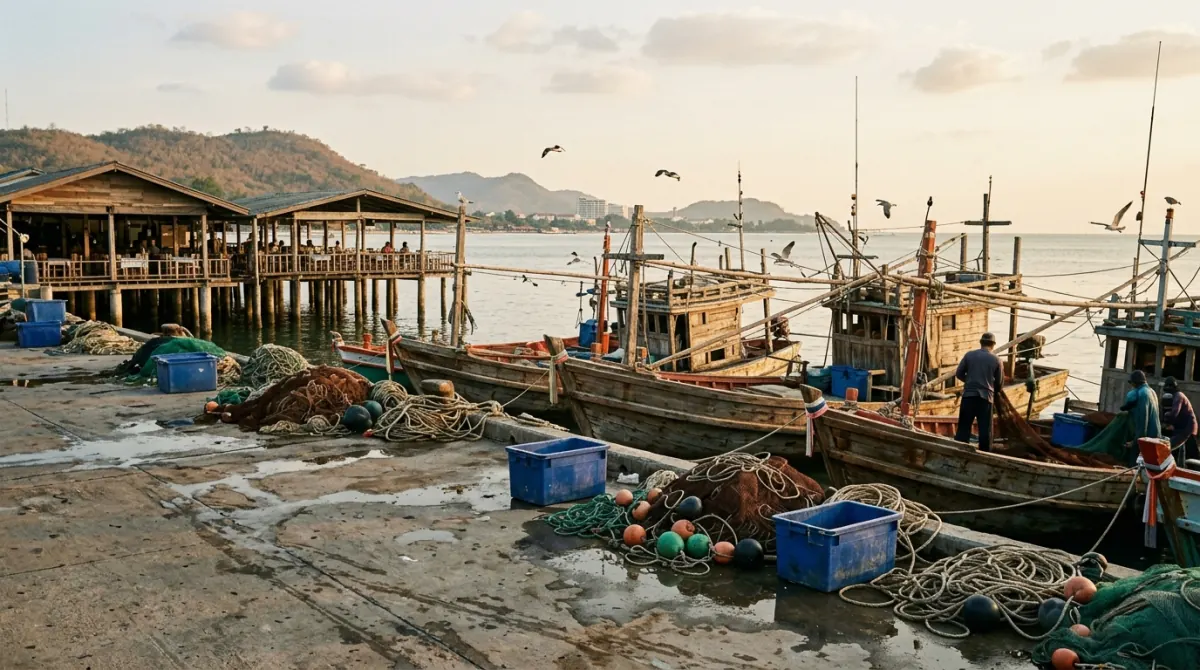
Hua Hin's dry stretch runs December to March — about 22 mm of rain a month and nine hours of sun a day. Stay in town to walk to dinner, Khao Takiab or Pranburi for quiet. The green songthaew costs 15 THB a leg; a tuk-tuk for the same trip wants ten times that.
At a glance
| Driest months | December to March · 86 mm of rain in total across all four |
| Wettest month | October, about 221 mm |
| Annual rainfall | About 1,100 mm — roughly 20% less than Bangkok, and well under half of Phuket's |
| Green songthaew | 15 THB per leg, 30 THB end to end (Khao Takiab to the airport) |
| Grab / Bolt car, in town | Roughly 60–80 THB for a typical cross-town trip |
| Tuk-tuk | No regulated tariff. Around 100 THB per km; 150–200 THB commonly asked for short trips |
| Motorbike taxi | 20–30 THB for a short hop; drivers wear numbered orange or purple vests |
| Rooms per night | About 400–900 THB budget · 1,500–4,000 THB mid-range · 5,000 THB and up beachfront |
| Long-stay condo | Roughly 10,000–30,000 THB per month depending on size and location |
| ATM fee, foreign card | 220 THB per withdrawal at most banks; some machines now show 250–350 THB |
| Tourist SIM | From 49 THB for a day; about 299 THB for 8 days and 15 GB |
| Hospitals with 24-hour emergency | Bangkok Hospital Hua Hin · San Paulo Hua Hin · Hua Hin Hospital (government) |
| Emergency numbers | 1669 ambulance · 1155 tourist police · 191 police |
Where you sleep decides how often you get into a vehicle
Chapter 1 sets out the four stretches of this coast that travellers use. Turned into a booking decision, they come down to one question: how much are you willing to drive after dinner.
Hua Hin town centre is the choice if the answer is "not at all". The night market, the bar strip, the fishing pier, the old railway station, the beach and most of the restaurants are inside a twenty-minute walk of each other. It is also the loudest and most built-up of the four, and rooms on the sois behind Phetkasem Road can be noisy until late. This is the right base for a two-night weekend without a car.
The beachfront resort strip runs north and south of the town centre, and it buys you sand, pools and space at the cost of a songthaew or a Grab every time you want dinner outside the hotel. It suits couples and anyone treating the hotel as the destination. It suits a family with a toddler and a 19:00 bedtime rather well.
Khao Takiab and Nong Kae, six to seven kilometres south, are the compromise. A quieter beach, larger resorts, the Cicada and Tamarind market pair on the doorstep — Chapter 4 has their opening nights — and the green songthaew running back into town for pocket change. The trade-off is that you will eat in the same handful of places unless you travel.
Pranburi, 30 km south and about half an hour by road, is for people who want the sea and nothing else. Design-led boutique places, an emptier shoreline, mangroves, and the approach road to Khao Sam Roi Yot. You will need a vehicle for every meal you do not eat at your hotel. Cha-Am, 25 km north, is the cheapest of the lot and the most Thai-domestic; it is a budget decision rather than a quality one.
Rough nightly bands
| Type | Typical band per night | What you get |
|---|---|---|
| Hostel bed or basic guesthouse room | 400–900 THB (about US$12–27) | Fan or basic air conditioning, in-town location, no view |
| Mid-range town hotel or serviced condo | 1,500–4,000 THB (about US$45–120) | Pool, breakfast, walkable to the market |
| Four-star, beach-adjacent | 3,000–6,000 THB (about US$90–180) | Grounds, several restaurants, a short walk to the sand |
| Beachfront resort | 5,000–12,000 THB (about US$150–360) | Direct beach access, kids' club, multiple pools |
| Destination spa and top end | Well above that | See Chapter 6 on the wellness end of the market |
Rooms are cheapest Monday to Thursday, because the town's core market is Bangkok weekenders who arrive on Friday and leave on Sunday, which is also what the town looks like on a Tuesday. They are dearest across the November-to-March high season. The direction of both patterns is solid; the size of them is not. Booking aggregators put the midweek average well below the weekend one, and the dearest month at roughly double the cheapest, but those are averages across every class of hotel on the site, not like-for-like comparisons of the same room, so plan around the pattern and not around a percentage. A long weekend shifted to Tuesday–Thursday in June is a materially different price from the same rooms on a Saturday in high season.
The seafood is better where the boats unload than where the menus have photographs
Hua Hin is a working fishing town with a resort layer on top, and the price of a plate of prawns depends almost entirely on which layer you are standing in.
The fishing pier (Saphan Pla), at the northern end of the seafront, is where the boats come in. There are seafood restaurants along and around it, and a walking market on the pier itself several evenings a week — Chapter 4 carries the market schedule, which is one of the less certain ones in town. Eating here means grilled squid and scallops on plastic chairs with the water underneath you. A generous seafood dinner for two with drinks runs roughly 1,000–3,000 THB (about US$30–90) depending on how much shellfish is involved.
Khao Takiab village, at the foot of the temple hill, is the other end of the same supply chain. The morning catch goes from the boats to the kitchens over a distance of a few metres, and the row of simple open-air restaurants along the shore charges noticeably less than the beachfront hotels for the same fish. Thai families fill these places at weekends. Some village restaurants close one day a week, so check the day before you make a special trip.
Naretdamri Road, in the town centre, is the seafront restaurant strip with decks built out over the water. It is the view-priced option, and it is the strip most often compared unfavourably with the night market on value.
Where residents actually eat is less photogenic and considerably cheaper:
- The mall food courts at Market Village and BluPort. Air-conditioned, 60–100 THB (about US$2–3) a plate, everything from boat noodles to grilled chicken, and the single best wet-afternoon option in town.
- The shophouse restaurants along Phetkasem Road and the sois off it, particularly around the Soi 51 and Chatchai Market end. Plastic stools, one or two dishes done properly, no English menu in many of them.
- The morning market. Chatchai is the town's everyday wet market and its breakfast canteen — Chapter 4 covers it, along with the newer local markets that have opened away from the tourist strip.
What to order
- Steamed sea bass with lime and garlic (pla kapong neung manao) — the dish to judge a seafood restaurant by.
- Crab in yellow curry powder (pu phat pong karee), and garlic-pepper crab, which is the version Thai tables order more often.
- Grilled prawns (kung phao) and grilled squid (pla muek yang). Squid is a genuine local speciality here; so is squid stir-fried with salted egg yolk.
- Steamed green mussels, sold by the kilo.
- Pineapple fried rice. Prachuap Khiri Khan grows more pineapple than any other Thai province, so this is a local product, not a tourist novelty. Buy the fruit itself at Chatchai.
- Salt-crusted whole fish grilled over charcoal, eaten with rice noodles, herbs and lettuce leaves. A pier-and-market dish, not a restaurant one.
Seafood is sold by weight almost everywhere in this town, and how that is quoted decides what you pay: Chapter 4 sets out what to settle before you order.
Hua Hin's dry season is not drier than Bangkok's — its wet season is much lighter
The table below is not a station record. It is a set of modelled long-term averages processed from CRU (University of East Anglia), UK Met Office and KNMI data and published by weather2travel, and the source does not state the period it averages over. Other aggregators put Hua Hin's annual total anywhere between about 997 mm and 1,117 mm, give October as high as 254 mm and February as low as 15 mm. Use it for the shape of the year — when the rain arrives, how long it stays, how heavy it is when it falls — and not for what one month will do to one week.
| Month | Avg high | Avg low | Rain | Rain days | Sun (hrs/day) |
|---|---|---|---|---|---|
| January | 29 °C | 21 °C | 14 mm | 2 | 9 |
| February | 31 °C | 22 °C | 24 mm | 3 | 9 |
| March | 32 °C | 24 °C | 30 mm | 3 | 9 |
| April | 33 °C | 25 °C | 42 mm | 4 | 8 |
| May | 33 °C | 25 °C | 124 mm | 14 | 7 |
| June | 33 °C | 25 °C | 91 mm | 16 | 5 |
| July | 32 °C | 25 °C | 108 mm | 17 | 5 |
| August | 32 °C | 25 °C | 113 mm | 18 | 5 |
| September | 32 °C | 24 °C | 139 mm | 17 | 5 |
| October | 31 °C | 24 °C | 221 mm | 17 | 6 |
| November | 30 °C | 23 °C | 176 mm | 9 | 7 |
| December | 29 °C | 21 °C | 18 mm | 2 | 9 |
| Year | ~1,100 mm | 122 |
Set against the places people compare Hua Hin with, on figures drawn from that same source, so the four columns at least measure the same way:
| Hua Hin | Bangkok | Koh Samui | Phuket | |
|---|---|---|---|---|
| Annual rainfall | ~1,100 mm | 1,394 mm | 1,741 mm | 2,815 mm |
| Rain days per year | 122 | 122 | 164 | 172 |
| Rain per wet day | ~9 mm | ~11 mm | ~11 mm | ~16 mm |
| December–March total | 86 mm | 71 mm | 404 mm | 192 mm |
| June–August total | 312 mm | 533 mm | 401 mm | 824 mm |
| Wettest month | October, 221 mm | September, 292 mm | November, 463 mm | September, 398 mm |
Hua Hin's dry season is not drier than Bangkok's. December to March, the two are effectively the same, and Bangkok is marginally drier on paper. Anyone selling Hua Hin as a dry-season escape from Bangkok rain is selling something that is not there. What you are escaping in those months is the city, not the weather.
The wet season is where the difference lives. Hua Hin and Bangkok have exactly the same number of wet days a year, but Hua Hin's deliver about a fifth less water — shorter bursts rather than longer sits. June to August, the months that soak the Andaman coast, Hua Hin gets roughly a third of Phuket's rain. That is the genuine case for coming here in the cheap months, and it is a good one: a July week in Hua Hin is a very different proposition from a July week in Krabi.
The calendar is offset from the islands. Hua Hin's wettest month is October and its rain has largely stopped by December. Koh Samui's wettest month is November, when Hua Hin is drying out. If your trip is in November and you are choosing between the two coasts, that single row of the table decides it.
The practical summary: the cool season starts in November, but the dry stretch is December to March — nine hours of sun, night temperatures around 21–23 °C, and the highest room rates of the year. November has few rain days, nine of them, but they are heavy ones: 176 mm falls in the month, more than December to March put together. It is the tail of the wet season, not the head of the dry one. April is the hottest month and still dry. May to October is the wet half, a wet half of light frequent showers, not washed-out days, with September and October the two months worth avoiding if the beach is the point. Kitesurfing conditions run on a different calendar again — Chapter 6 covers the wind season.
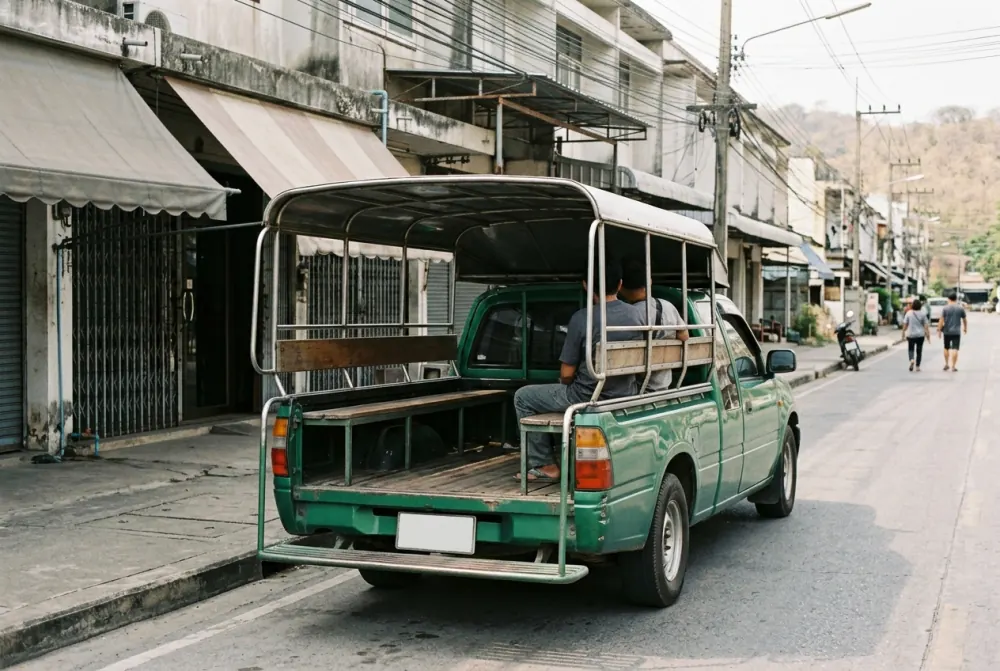
The green songthaew costs 15 baht; the tuk-tuk beside it wants 150
Hua Hin has functioning cheap local transport and an unusually expensive tuk-tuk trade sitting right on top of it, and the two are hard to tell apart from the pavement.
The green songthaew is the backbone. It runs the 12.5 km along Phetkasem Road between Khao Takiab in the south and Hua Hin Airport in the north, through the town centre, and the route is split into two legs at Chatchai Market. You pay per leg: 15 THB (about US$0.45), so 30 THB end to end. Flag it down anywhere along the road, sit on the bench in the back, and pay the driver when you get out. Service runs roughly 06:00 to 21:00 Monday to Thursday and to about 22:00 at weekends, about every ten minutes in high season and every twenty in low season.
Older guides list other colour-coded songthaew routes — orange, white, and white-with-a-red-stripe — running to Makro, Huay Mongkol temple and around an urban ring. Sources contradict each other about whether these still operate, with several stating that only the green route has survived since the early 2020s. Treat the green route as the only dependable one and plan nothing around the others.
Grab and Bolt both work in Hua Hin, and in the central area a car typically arrives in three to five minutes. This is the single most useful thing to install before you arrive. A Khao Takiab to BluPort run costs roughly 60–80 THB (about US$2) by app. The price is fixed in the app before you accept, which removes the negotiation entirely.
Tuk-tuks in Hua Hin are expensive by Thai standards, consistently so across every source. There is no regulated tariff, and no per-kilometre logic either — what drivers quote is a near-flat number that barely moves with distance, which is why short hops feel worst. Real quotes travellers report: about 150 THB (about US$4.50) from Tamarind Market to the night market, 150 THB one way from the town centre to Khao Takiab, and 150–200 THB asked for a one-way run out to the Soi 94 bar area. One 2026 guide gives 60–100 THB as the band for short in-town hops, which is the lower end of what gets quoted.
Put next to each other: the town-centre-to-Khao-Takiab trip is 15 THB by songthaew, roughly 60–80 THB by Grab or Bolt, and about 150 THB by tuk-tuk. Drivers here are also noted as less willing to negotiate than in most Thai towns, so if the number sounds high, the productive move is usually to walk to the main road and wait for a songthaew instead of haggling.
Motorbike taxis cover short distances for 20–30 THB — about 30 THB from the railway station to the night market is a commonly reported example. Drivers wait at fixed points wearing numbered orange or purple vests. They are the fastest way across town at 18:00 on a Friday.
Renting your own costs roughly 150–200 THB a day for a motorbike, about 1,550 THB a week for a 160cc, and around 8,500 THB a month for a 350cc. A small car runs about 12,000–14,000 THB (about US$360–420) a month. Two conditions apply and they are not negotiable: you need the correct licence category, which for a motorbike means an International Driving Permit with a motorcycle entitlement, and helmets are compulsory. Riding without the right licence usually voids your travel insurance as well as your rental cover, and motorcyclists account for the overwhelming majority of Thailand's road deaths.
The road is the real hazard in Hua Hin, not the crime rate
Hua Hin is a low-crime, low-hassle town, and the things most likely to spoil a trip here are traffic, sun and an unlucky encounter with a monkey. In that order.
Hospitals. Three facilities in and near the town centre run 24-hour emergency departments, all on or just off Phetkasem Road:
- Bangkok Hospital Hua Hin — private, part of the national Bangkok Hospital group, English-speaking staff and international patient coordinators. It is mid-way through an expansion from 60 patient rooms to 150, with the outpatient clinics going from 20 to 35 and the ICU and emergency room doubling; completion was scheduled for 2026, so expect building works.
- San Paulo Hua Hin Hospital — private, around 60 beds, 24/7 emergency unit, accredited by Thailand's Healthcare Accreditation Institute.
- Hua Hin Hospital — the government hospital. Cheapest by a wide margin, longest waits, and less English than the two private options.
There are also private clinics and a Bangkok Hospital satellite clinic at Market Village for things that do not need an emergency room. Private hospital treatment in Thailand is good and it is not cheap: travel insurance is the difference between an inconvenience and a five-figure bill.
Emergency numbers: 1669 for an ambulance, 1155 for the tourist police, 191 for police. All are free to call and 1155 is staffed for English.
Monkey bites are a same-day hospital job. Chapter 5 carries the macaque warning in full; the medical half belongs here. Wash any bite or scratch with soap under running water for several minutes, then go to a hospital the same day — not a pharmacy, and not tomorrow. Rabies post-exposure treatment is a hospital procedure, and Thailand treats every monkey bite as a possible exposure.
Crossing the road takes active attention. Thailand's road traffic death rate was 25.4 per 100,000 people in 2021 on WHO figures — around 18,200 deaths a year, with motorcyclists making up close to 84% of them. Marked crossings are not reliably honoured. Phetkasem Road through Hua Hin carries fast through traffic in both directions, and motorbikes travel on pavements and against the flow of traffic as a matter of routine. Cross at lights where there are lights, look both ways even on a one-way street, and hold children's hands throughout.
The sun is stronger than the sea breeze suggests. December to March averages nine hours of sunshine a day, the beach has very little natural shade, and the onshore wind masks how much of it you are taking. The usual rules apply harder here than they do at home. One local point: if your Hua Hin trip includes Khao Sam Roi Yot, note that Thailand has banned sunscreens containing oxybenzone, octinoxate, 4-methylbenzylidene camphor or butylparaben from its national parks since August 2021, with fines of up to 100,000 THB. Check the ingredient list before you pack.
Water conditions, jellyfish and swimming are Chapter 3's subject.
Money, a SIM and two pieces of paperwork
Cash still runs the bottom half of the economy here. Markets, songthaews, motorbike taxis, street food and most small shophouse restaurants are cash-only. Cards work at the malls, supermarkets, hotels, chain restaurants and the larger sit-down restaurants. Thai QR payment is now near-universal among small vendors, but it generally requires a Thai bank account, so as a visitor you will still be carrying notes.
ATM fees are the thing to plan around. Thai banks charge a foreign-card fee of 220 THB (about US$6.70) per withdrawal at most machines, and in 2026 some ATMs display 250 THB, with up to 350 THB reported on certain foreign Mastercards. AEON machines charge 150 THB. Because the fee is per transaction, not per baht, the arithmetic is simple: withdraw the maximum and withdraw rarely. Per-transaction caps run from 20,000 THB at Kasikorn to 30,000 THB at Bangkok Bank, Krungsri and SCB. A 30,000 THB withdrawal at 220 THB costs you 0.7%; a 5,000 THB one costs 4.4%. Always decline the machine's offer to charge you in your home currency — that conversion is worse than your own bank's.
SIM and eSIM. Buy at the airport on arrival, where AIS, True and dtac all have counters in the arrivals halls at Suvarnabhumi and Don Mueang, or at the operators' shops in Market Village and BluPort once you are here. Tourist plans start at about 49 THB for one day with 1 GB; the common choice is around 299 THB (about US$9) for 8 days and 15 GB, which is more than enough for maps, messaging and video calls. True's tourist range runs roughly 449–1,199 THB for 8, 15 or 30 days. All the major operators sell eSIMs, so if your phone supports one you can be connected before you land. Coverage in the town and along the coast road is good.
Two pieces of paperwork. The Thailand Digital Arrival Card (TDAC) is mandatory for every foreign national entering Thailand by air, land or sea, including children, and it replaced the old paper form. It is free, takes about ten minutes, and can only be submitted in the 72 hours before you arrive. The only official site is tdac.immigration.go.th; anything charging a fee for it is not official.
The visa exemption is in flux, and this matters if you are planning a long stay. On 19 May 2026 the Cabinet approved replacing the 60-day visa exemption with 30 days for most nationalities and 15 for a few. As of late August 2026 that change had not taken effect: it starts 15 days after publication in the Royal Gazette, and publication had not happened, so the 60-day exemption still applied. Your stay length is set by the date you physically arrive. Check the current position with a Thai embassy before you book anything that depends on it.
Why so many visitors come back for a month
Hua Hin has a large resident population of retirees and repeat long-stayers, and the reasons are practical, not romantic.
The infrastructure is the main one. Two private hospitals with English-speaking staff and 24-hour emergency departments is unusual for a town this size, and it is the thing people over 60 weigh most heavily. There are two malls with Western supermarkets, a functioning wet market, an international school, and eight golf courses within about half an hour of town — Chapter 6 names them. Underneath the resort layer there is a real Thai town that does not shut down in the low season.
The maths works too. A studio or one-bedroom condo rents from roughly 10,000 THB (about US$300) a month at the bottom end, with the more common range for something comfortable near the beach at 15,000–30,000 THB. Houses and villas run from about 28,000 THB upward. Add 8,500 THB a month for a motorbike or 12,000–14,000 THB for a small car, and a month in Hua Hin costs a fraction of a month in a hotel anywhere.
The climate helps in a specific way. As the table above shows, the wet season here is lighter than Bangkok's and much lighter than the islands', which means a three-month stay from December has a genuinely high chance of dry weather and a three-month stay from June is not a write-off.
And the logistics help. Two international airports sit about three hours away by road, which makes visitors from home easy to receive and a mid-stay trip out of the country straightforward to arrange.
The case against: it is quiet. Public transport does not usefully reach anything outside the town, so a long stay without your own wheels means a lot of app bookings. Weekends are busier and more expensive than weekdays all year. And if you need a city, Bangkok is a three-hour drive each way, which is a day gone.
For long-stayers who want to stay longer than a tourist stamp allows, the Destination Thailand Visa is the route most often used now: five years' validity, up to 180 days per entry with one in-country extension possible, a 10,000 THB fee, and a requirement to show 500,000 THB in savings or income. There is also a long-standing retirement route for over-50s with its own financial thresholds. Both change, and neither should be planned from a travel guide — take advice from a Thai embassy or a licensed visa agent.
Frequently asked questions
What is the best time to visit Hua Hin?
December to March: roughly 22 mm of rain a month and about nine hours of sunshine a day. It is cool from November, but November itself still takes 176 mm across nine rain days, so treat it as the tail of the wet season and pack for it. Those same months are the high season, so rooms cost the most and midweek nights cost less than weekend ones. If price matters more than certainty, June to August is a fair bet here — Hua Hin gets around a third of Phuket's rain in those months, and it arrives as short showers, not whole wet days.
Where should I stay in Hua Hin?
In the town centre if you want to walk to dinner, the markets and the beach without using transport. On the beachfront strip if the hotel is the holiday. Khao Takiab for a quieter beach with the town still fifteen minutes away by songthaew. Pranburi if quiet is the entire point and you have a vehicle. Cha-Am if the budget decides it.
How do you get around Hua Hin without a car?
The green songthaew along Phetkasem Road covers the Khao Takiab–town–airport axis for 15 THB a leg, roughly 06:00 to 21:00. Grab and Bolt fill every gap for around 60–80 THB a trip and arrive in a few minutes in the centre. Motorbike taxis handle short hops for 20–30 THB. Skip the tuk-tuks unless you have no alternative.
Are Hua Hin tuk-tuks expensive?
Yes, unusually so for Thailand. They are unmetered and there is no regulated tariff. In practice the quote barely moves with distance: about 150 THB whether the trip is one kilometre or seven, against 15 THB on the songthaew and 60–80 THB by app. Drivers here negotiate less readily than in most Thai towns. Always agree the fare before you get in.
Is Hua Hin expensive?
It has the widest price range of any Thai beach town. Street food is 50–100 THB a plate and food-court meals are similar; hostel beds start around 400 THB; and the same coastline carries some of Thailand's most expensive resorts. What raises the average is accommodation and the beachfront restaurants, not day-to-day living. Eat where residents eat and it is an inexpensive town.
Where do locals eat in Hua Hin?
At Chatchai morning market, at the mall food courts in Market Village and BluPort, at the shophouse restaurants along Phetkasem and its side sois, and at the simple seafood places in Khao Takiab village where the boats unload. The common thread is that none of them have a sea view, and all of them cost a fraction of the places that do.
Keep reading
- The green songthaew and the ride-hailing apps cover the town and stop at its edges: none of them reaches the cave, the vineyard or the national park. A car and driver is one way to cover those in a day, and there is no published day rate for it — ask for a written all-in quote naming hours, kilometres, waiting time and the overrun rate before you commit. Chapter 8 sets out which days are worth one.
Last updated: 2026-08-29.