
Hua Hin Travel Guide · Chapter 1 of 8
Hua Hin at a Glance: Town, Beach and the Royal Coast
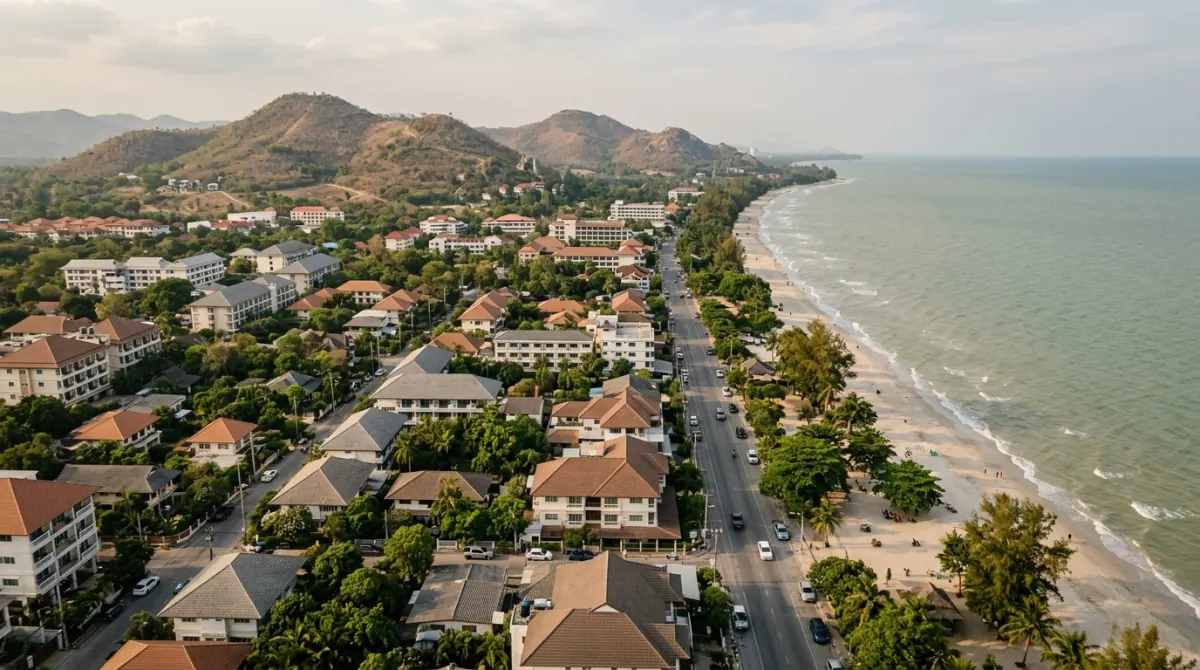
Hua Hin is a mainland beach town on the Gulf of Thailand's western shore, about 200 km and roughly three hours south-west of Bangkok. It has been a royal railway resort since the 1920s, and it stayed low-rise, orderly and family-first. Its appeal is that it is calm and easy to reach, not that it is spectacular.
At a glance
| Province | Prachuap Khiri Khan, on the western — mainland — shore of the Gulf of Thailand |
| Distance from Bangkok | About 196–200 km by road, roughly 3 hours when the road is clear. Routes, trains, airport distances and whether you can fly are all in Chapter 2 |
| Population | 126,355 registered residents across Hua Hin district, January 2025; the town itself is far smaller |
| Settled | Farming settlement from around 1834 |
| Resort founded | Southern railway arrived 1911; the Railway Hotel took its first guests 26 October 1922 |
| Royal anchor | Klai Kangwon Palace, commissioned by King Rama VII in 1926 |
| Golf | Royal Hua Hin, Thailand's first course — first nine holes 1922, royally inaugurated 28 June 1924. Eight courses now sit within about 30 minutes of town (Chapter 6) |
| Four zones | Hua Hin town · Khao Takiab 6–7 km south · Cha-Am 25 km north · Pranburi 30 km south |
| Coolest and driest months | Coolest November to February; driest December to March. November is cool but still the tail of the wet season — Chapter 7 has the month-by-month figures |
| The beach in one line | Long, flat, walkable, safe for children — and not island-blue |
Hua Hin is mainland coast, and that settles the shape of the trip
Hua Hin sits on the Gulf of Thailand's western shore, on the narrow neck of land that runs south towards Malaysia with Myanmar close behind it. The town faces roughly east across the water, so the sun rises over the sea and sets behind the hills inland.
That one geographic fact does more work than it looks. Because Hua Hin is on the mainland, there is no boat, no island hop, no tide-dependent pier and no weather cancellation between you and your hotel. Which route, which train, which terminal and what each option costs in time are worked through in Getting to Hua Hin from Bangkok and the Airports.
Hua Hin is also close enough to Bangkok to work as a day trip — which almost no Thai island destination does — and close enough that Thai families come down for a single night. That is why the town fills on Friday evening and thins out on Sunday afternoon, and why hotel rates and restaurant waits follow the same rhythm. Chapter 8 sets out what actually fits into a day, a weekend and three days.
A railway and a palace built this town, and it still behaves like both
This coast was a farming settlement from around 1834. The Southern railway line reached it in 1911, which put a long stretch of empty beach within a few hours of Bangkok's court and aristocracy for the first time. By 1916 it was a routine overnight stop on southbound journeys, with basic railway accommodation.
Prince Purachatra of the State Railways then built something better to hold the traffic: the Railway Hotel, designed by the State Railways' Italian architect Alfredo Rigazzi, which received its first guests on 26 October 1922 and held its formal opening on 1 January 1923. It survives, restored and expanded, as the Centara Grand Beach Resort. It also stood in for Phnom Penh's Hotel Le Phnom in the 1984 film The Killing Fields, which is why the colonial-era frontage looks familiar to some visitors who have never been to Thailand.
Golf followed. Royal Hua Hin — laid out by a Scottish railway engineer named Robins, on the slope directly behind the station — opened its first nine holes in 1922, was royally inaugurated on 28 June 1924, and had its full eighteen by 1928. It is the oldest course in the country. Golf here is a century old, not a resort amenity bolted on in the 1990s, and that lineage still shapes who comes.
Then came the palace. King Rama VII commissioned Klai Kangwon — the name means "far from worries" — in 1926, on personal land, at the northern end of town. It is not a museum and never has been: it is a working royal residence. It is also where the King was staying on 24 June 1932 when the People's Party seized Bangkok and ended the absolute monarchy. He was formally invited back to the capital, travelled up by special royal train on the night of 25 June, and signed a temporary constitution on 27 June. Thailand's transition to constitutional monarchy was, briefly, a Hua Hin story.
Sources do not agree on when the palace was finished. The Tourism Authority of Thailand gives 1929; Wikipedia gives 1933. The likeliest explanation is that the main residence was in use years before the wider complex was complete, but nothing this guide could find settles it.
Nearly a century of royal residence at the north end of a small beach town has left marks a visitor notices inside an hour:
- It is low-rise along the water. The beachfront is hotels and villas of a few storeys rather than a wall of towers. It is widely repeated locally that a height limit protects the palace's sightlines, and this guide could not source any published ordinance saying so — treat that explanation as folklore, and the pattern on the ground as real. It is the clearest visual difference between Hua Hin and Pattaya. Inland, around the malls and the new condo blocks, buildings have crept upwards.
- It is orderly. There is a permanent official and security presence in town. Pavements get swept, the beach gets cleaned, and public upkeep runs above what a town this size would normally manage.
- It grew Thai-first. Hua Hin's core market has always been Bangkok weekenders and Thai families, with foreign visitors arriving later and in smaller numbers. The town was never rebuilt around a backpacker circuit or a mass package trade, and that is still legible in the street layout, the restaurants and the pace.
The four zones
Travellers use four stretches of this coast. They are 25 to 30 minutes apart at most, which sounds interchangeable and is not.
Hua Hin town. The centre, running back from the beach around Naretdamri, Dechanuchit and Phetkasem Roads, and the only one of the four where the fishing pier, the night market, the bar strip, the old railway station and the long-established beachfront hotels are all within a walk. It is also the busiest and most built-up.
Khao Takiab. Six to seven kilometres south, ten to fifteen minutes by road, at the headland that closes the southern end of the bay: the temple hill and its resident macaques, a quieter beach, the Cicada and Tamarind market pair, and a run of larger resorts with more space per guest.
Cha-Am. Twenty-five kilometres north, 25–30 minutes by car, over the provincial line into Phetchaburi. A wide, casuarina-shaded Thai domestic beach — deckchairs and groups of friends rather than boutique — with foreign visitors in a clear minority and few restaurants clustered within walking distance of the seafront hotels.
Pranburi. Thirty kilometres south, about thirty minutes. The quietest of the four: design-led boutique resorts strung along a far emptier shoreline, mangroves behind it, nothing walkable for dinner, and the approach road to Khao Sam Roi Yot National Park. The coast does genuinely improve as you go south, and Chapter 3 makes that case properly.
Chapter 7 turns these four zones into a where-to-stay decision and covers moving between them.
Hua Hin vs Pattaya vs Cha-Am
These are the three beach towns within a short drive of Bangkok, and the choice between them is the comparison people search for.
| Hua Hin | Pattaya | Cha-Am | |
|---|---|---|---|
| Distance from Bangkok | ~200 km, about 3 hours by road | ~145 km, about 1.5–2 hours | ~175 km, about 2–2.5 hours |
| Beach and water | Long, flat, clean sand. Water is greenish-brown and sediment-heavy, worse after rain. No evidence of a water-quality problem, and no site-level data either way (Chapter 3) | Central beaches are crowded and the water is the weakest of the three. The good water is on the offshore islands, which means a boat | Wide, long, shallow, shaded by casuarinas. Water much like Hua Hin's, sometimes murkier |
| Nightlife | A compact bar-and-live-music strip that fades around midnight. Not the reason to come | The largest and most explicit nightlife economy in Thailand. This is Pattaya's defining industry | Minimal. Beachfront seafood, deckchairs, Thai groups drinking on the sand |
| Families | The strongest of the three by a wide margin — safe, low-rise, walkable, golf, and no red-light district to route around | Workable in specific enclaves such as Jomtien and Naklua, but the centre is not where you walk children after dark | Fine, and popular with Thai families, though with fewer options for a wet afternoon |
| Price | Broad range: cheap guesthouses through to some of Thailand's most expensive beach resorts | The deepest supply of cheap rooms and cheap drinks in the country | The cheapest of the three overall |
| Getting around | Songthaew and ride-hailing apps work; tuk-tuks are expensive. See Chapter 7 | Dense baht-bus network — the easiest of the three without a car | The thinnest local transport. You will want a vehicle |
| Wrong for | Anyone whose trip is built on nightlife or clear water | Families wanting a walkable centre; anyone travelling in order to rest | Anyone who wants to walk to a choice of restaurants and evening options |
The price row above is a relative ordering drawn from what each town has on its shelves, not a rate survey, and any given week can invert it.
The short version: Pattaya is an hour closer to Bangkok and has far more of everything, including the things some travellers are actively trying to avoid. Hua Hin costs an extra hour of driving and buys calm. Cha-Am costs less than either and gives you less to do with the saving.
Who Hua Hin rewards, and who leaves disappointed
It works well for:
- Families with young children. A shallow, gently shelving beach; short walking distances; a town where nothing needs to be planned around. This is the single strongest case for Hua Hin over its rivals, and it is a structural advantage rather than a matter of taste.
- Golfers. A century of golf history and eight courses within about 30 minutes of town, at green fees that swing sharply between high season and the cheaper months. Chapter 6 has the courses and the numbers.
- Long-stay and repeat visitors. Hua Hin holds a large population of retirees and returning visitors for concrete reasons: working hospitals and supermarkets, a real Thai town underneath the resort layer, monthly condo rates, and a shorter wet season than Bangkok's. People come for a fortnight and come back for three months.
- Bangkok weekenders. Close enough that leaving on Friday evening and returning on Sunday evening is a weekend rather than a travel exercise.
It disappoints:
- Anyone whose holiday is built around nightlife. The strip near the Hilton is small and quiet on weeknights, so if the bar scene is the reason for the trip, go somewhere else. Chapter 4 describes what the evenings here actually are.
- Anyone expecting island water. The Gulf's western shore is shallow, silty and stirred up by wind and rain. Visitors who arrive fresh from Krabi or the Andaman islands are consistently let down, and they are not being unfair. This beach is for walking, running, riding and letting children paddle. It is not for snorkelling and it is not for photographs of the water.
- Travellers without transport who want to roam. The vineyard, the big temples, the cave at Khao Sam Roi Yot and the national park sit 15–60 km out of town, and public transport does not usefully reach any of them. In town a songthaew and a ride-hailing app cover most needs; beyond it, you are on your own wheels or someone else's.
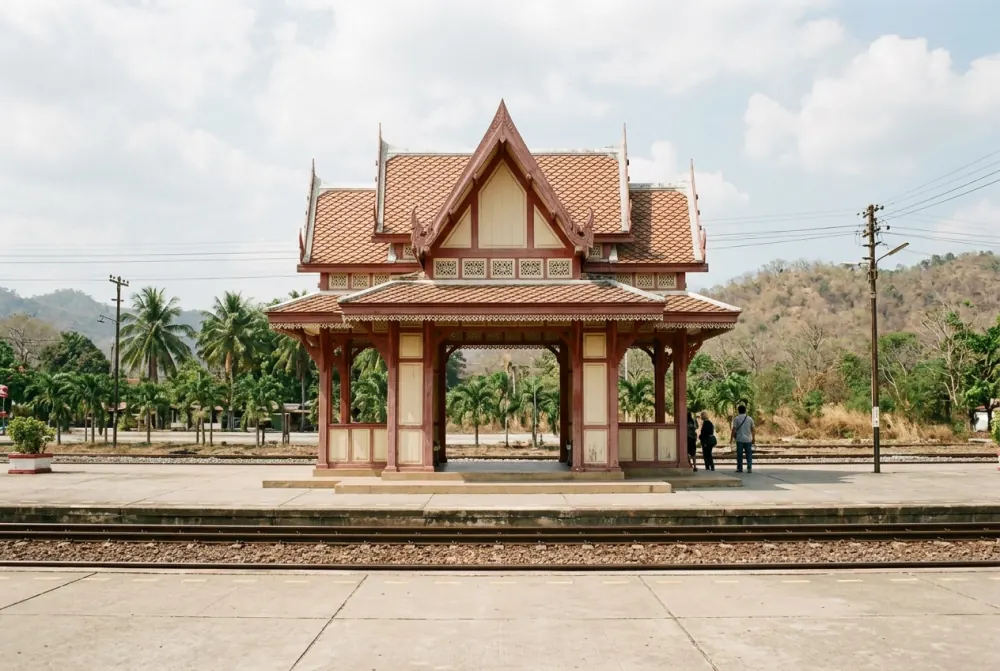
The old railway station explains the rest of the town in fifteen minutes
If you stop at one thing in the centre, stop here — and know what you are looking at, because the station is now two buildings twenty metres apart.
Passenger trains have used a new elevated station since 11 December 2023, part of the Southern Line double-tracking. The old station, 112 years old when it was retired, still stands beside it, preserved and maintained as a historic building by the Fine Arts Department. That red-and-cream timber structure is the one in every photograph of Hua Hin.
The ornate pavilion next to it is the royal waiting room. It was not built for this station, or for this town. It began as a royal pavilion at Sanam Chandra Palace in Nakhon Pathom, built in the reign of King Rama VI, who used it while reviewing his Wild Tiger Corps; the State Railway dismantled it and re-erected it at Hua Hin to save it. Most accounts, including Hua Hin Today's, give the move as 1974, though some sources say 1967 or 1968 and none of them cite a record.
It takes a quarter of an hour and costs nothing. It is also the clearest physical statement of what this place is: a beach town that exists because a railway carried a royal court to it, and that has spent a hundred years being tidy about the fact.
Frequently asked questions
Is Hua Hin worth visiting?
Yes, if you want a calm, safe, easy beach town within three hours of Bangkok. No, if you are looking for spectacular scenery. The water is not clear and the nightlife is small. What Hua Hin offers instead is a walkable centre, very good food, golf, night markets and an absence of hassle, which is what most weekenders and long-stay visitors are actually after.
Hua Hin or Pattaya — which is better?
For families, golfers and anyone travelling in order to rest, Hua Hin. For nightlife, cheap rooms and the most to do at any hour, Pattaya. Pattaya is also an hour closer to Bangkok and cheaper across the board; Hua Hin is quieter, tidier, better for children, much better for golf, and has the better beach to walk. Neither has clear water — for that you need the islands or the Andaman coast.
Is Hua Hin good for families?
It is one of the better beach choices in Thailand for young families. The beach shelves gently, the centre is compact and walkable, and no part of town has to be routed around in the evening, which is the practical difference from Pattaya. The wet-afternoon option most guides name is Vana Nava, the water park at the southern edge of town, reported open daily 11:00–17:00 — but the operator's own site was serving a temporary-closure banner in August 2026, so ring 032-909-606 before you build a day around it. Black Mountain Water Park, on 032-618-444, is the fallback. Chapter 6 covers both.
Can you visit Klai Kangwon Palace?
Not reliably. It is an active royal residence rather than a museum, and access depends on whether the royal family is in residence. Some guides publish visiting hours for the grounds and others say the exterior only. Nothing official confirms either version, so treat the palace as history that shaped the town rather than a stop on an itinerary.
Keep reading
- Also useful: Hua Hin Itineraries: Weekend, Three Days and a Day Trip — how these four zones fit into the time you actually have.
- If your plan spans the zones — a Pranburi hotel, a vineyard afternoon, a cave at dawn — they sit 15–60 km apart with no useful public transport between them, which is what a private car and driver solves. The only published fares are the fixed one-way transfers in Chapter 2; a full day has no rate card and is quoted per itinerary, so ask for a written all-in quote naming hours, kilometres, waiting time and the overrun rate before you commit.
Last updated: 2026-08-29. Route timing and road notes come from Smile Taxi Service drivers who run Bangkok-Hua Hin transfers daily.