
Hua Hin Travel Guide · Chapter 2 of 8
Getting to Hua Hin from Bangkok and the Airports
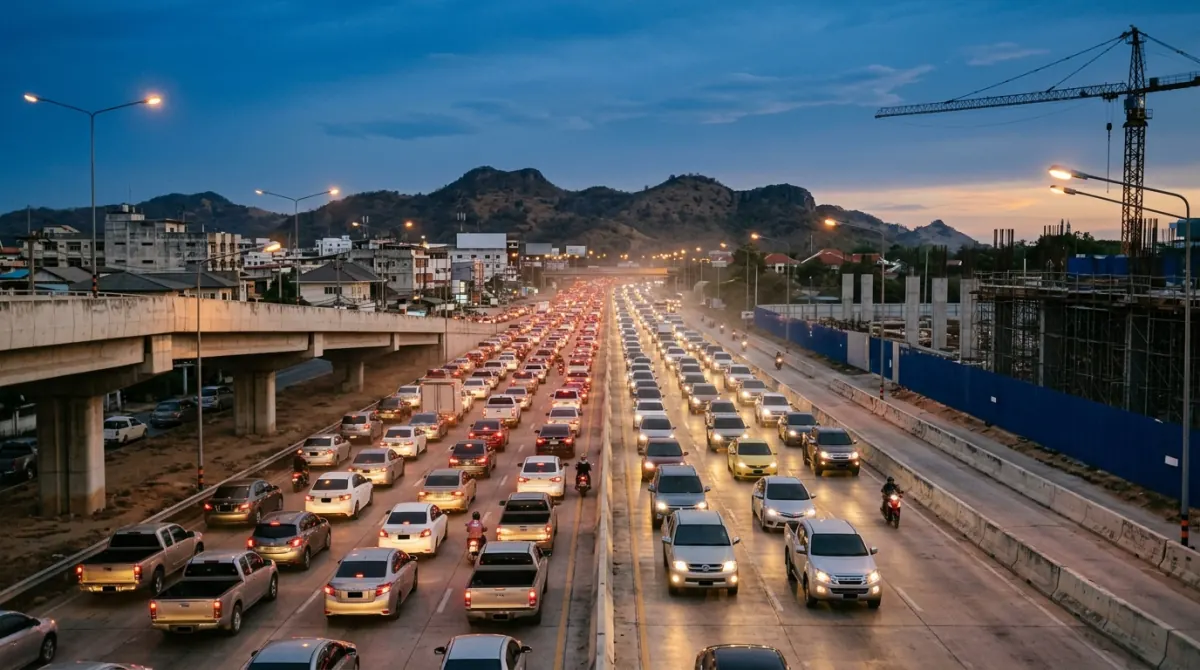
Hua Hin is about 200 km south of Bangkok, roughly three hours by road when the road behaves. A private car is the only door-to-door option and the only one that absorbs a late flight; the train is the better journey on an awkward timetable. Rama II Road, not distance, decides your arrival time.
At a glance
| Central Bangkok to Hua Hin | About 196–200 km |
| Suvarnabhumi (BKK) to Hua Hin | About 220 km |
| Don Mueang (DMK) to Hua Hin | About 221 km |
| Typical car journey, either airport | 3–3.5 hours; 4.5–5 hours on a holiday weekend |
| Private transfer, one way per vehicle | Sedan 2,000 from all three; SUV 2,200 from Suvarnabhumi and 2,300 from Don Mueang or the city; Van 2,800 THB. Tolls included |
| Private transfer, Pattaya to Hua Hin | Sedan 3,200 / SUV 3,500 / Van 4,300 THB (about US$95 / 105 / 130) |
| Free waiting on airport pickups | 60 minutes |
| Train | Krung Thep Aphiwat, 229 km, 3h01 at best, 8–10 services daily |
| Bus and minivan | Sai Tai Mai, Ekkamai or Mo Chit 2; about 180–310 THB; 3.5–4 hours running time |
| Direct airport coach | Roong Reuang Coach, Suvarnabhumi Level 1 by Exit 8, about 4 hours, around 478 THB |
| Pattaya to Hua Hin ferry | Not operating. Suspended March 2020, contract cancelled 2021, nothing since |
| Scheduled flights from Bangkok | None |
Dollar figures in this chapter convert at 33 THB to US$1 (August 2026). The baht fares are fixed; only the conversion moves.
Four ways south, and the gap between them is hours rather than money
There is no fifth. Hua Hin has an airport, but its only scheduled service is a Thai AirAsia route to Chiang Mai. Nobody flies here from Bangkok, and a twenty-minute flight would be swallowed whole by the transfers at each end anyway.
| Option | Cost | Door-to-door time | Comfort | Luggage | Who it suits |
|---|---|---|---|---|---|
| Private car | 2,000–2,800 THB per vehicle, tolls included, however many of you there are | 3–3.5 hours from either airport; 4.5–5 hours on a holiday weekend | Your own vehicle, your own stops, air conditioning, no changes | Boot space; a van takes golf clubs, a family's cases or a pushchair | Anyone with a flight to meet, families with young children, golfers, late arrivals, and anyone who would rather not think about it |
| Minivan | 180–310 THB per person (about US$5–9) | 4.5–5.5 hours from a central Bangkok hotel | Cramped, fixed seating, one comfort stop | One bag, and on a full van it may ride on your lap | Solo travellers on a budget, travelling light |
| Bus | 180–220 THB per person (about US$5–7); VIP coaches from around 490 THB | 4.5–5.5 hours from a central hotel | Reclining seats, air conditioning, a stop at Cha-Am | Hold luggage, no practical limit | Budget travellers with a suitcase and time to spare |
| Train | 44–94 THB third class, 150–330 THB second-class air-conditioned seat, around 620 THB for a sleeper berth | 5–6 hours from a central hotel on most departures | The most space of the four, and the only one you can walk around in | Generous and informally handled | People who want the journey to be part of the trip, and anyone who can take the 07:30 |
The public-transport times in that table are door-to-door, not the operator's running time. They include crossing Bangkok to reach the terminal, which is the part that quietly eats an hour, and getting from the drop-off to your hotel at the Hua Hin end. A bus company quoting 3.5 hours is being accurate about the bus and silent about the other two hours.
The money gap is wider than the convenience argument usually admits. A minivan for a couple is 360–620 THB against 2,000 THB for a sedan. For a family of four, four bus tickets come to 720–880 THB at Sai Tai Mai's 180–220 THB, or 1,164–1,232 THB if you leave from Ekkamai or Mo Chit, where the same journey is 291–308 THB a seat. Add 60–150 THB for the taxi from Hua Hin bus station to a hotel (Chapter 7 prices the local runs) and the range is 780–1,382 THB against 2,800 THB for a van — so the van costs somewhere between about 1,400 and 2,000 THB more, depending which terminal you can actually get to. The gap only closes against the VIP coaches at around 490 THB a seat: four of those plus the station taxi is 2,020–2,110 THB, and the van is about 700 to 800 THB dearer.
So the honest spread is roughly 700 THB against VIP coaches at one end and about 2,000 THB against the cheapest ordinary bus at the other. What the extra buys is specific: one vehicle from the arrivals hall to the hotel door, no terminal at either end and no changes in between, a flight number that a person checks before the driver sets off, sixty minutes of free waiting built into the fare, and a boot that takes four suitcases without anyone holding a bag on their knees. Whether that is worth 1,800 THB depends on who is travelling with you and what time you land. It is a judgement, not a calculation.
Rama II Road sets the clock, and 2026 changed it in both directions
Every road route south from Bangkok funnels onto Highway 35, universally called Rama II Road. It has been a construction site for so long that Thais call it the seven-generation road. It is the single reason a 200 km drive can take five hours, and it is the only part of this journey worth planning around.
Two things happened in 2026, and they pull opposite ways.
The M82 elevated motorway is now open end to end. Its final 16.4 km section, Ekkachai to Ban Phaeo, opened for free public trial at 10:00 on 28 August 2026. Joined to the 8.3 km Bang Khun Thian to Ekkachai section that opened for trial in October 2025, that gives 25 km of continuous elevated road flying over the worst-affected stretch of Rama II. It is toll-free for the whole trial. Toll and traffic-control installation is not due to start until 2027 and takes about two years, so charging is not expected before 2029.
The rest of the programme is not finished and has slipped again. The surface-level Rama II widening and the parallel Rama III–Dao Khanong–Western Outer Ring Road expressway were pushed back to mid-2027 by the transport minister in April 2026, blamed on material costs — asphalt paving has roughly doubled — and on the disruption that followed a fatal crane collapse on 15 January 2026. That collapse dropped a launching gantry and concrete segments onto traffic below, killed two people, and led to the main carriageway being closed for sixty days while everything crawled along the frontage roads. Department of Highways figures reported in the press count more than 2,200 construction-linked accidents on this road between 2018 and 2025, with at least 140 deaths. The elevated deck is open; the works underneath it are staying for another year at least.
Trial-period rules worth knowing before you set off. Cars are limited to 80 km/h and buses and trucks to 65 km/h. Four access points are open — Phanthai Norasing, Maha Chai 1, Maha Chai 2 and Ban Phaeo — while Samut Sakhon 1 and 2 were still under construction at the opening, with end of 2026 given as the target. And motorcycles are banned outright from the elevated deck, along with bicycles and pedestrians, so anyone riding down to Hua Hin on two wheels stays on the old surface road with the construction and gets none of the benefit.
The departure windows to avoid
The delay is not spread evenly through the week. It concentrates in two predictable blocks, and knowing them is worth more than any route trick.
What our drivers plan around, in practice:
- Leave Bangkok before about 10:00, or in the 10:00–14:00 window. These run clean on most days.
- Do not set off between about 14:00 and 20:00 on a Friday. If that is the only slot you have, leaving after 20:00 usually arrives sooner than leaving at 16:00, even though it feels like a later start.
- Coming back, clear Samut Sakhon before about 14:00 on a Sunday, or leave it until after 21:00.
- Add an hour to everything over Songkran, New Year and the long weekends around them. Roadworks are suspended and lanes reopened for the biggest holidays, which helps, but the traffic volume more than cancels it out.
The dates that matter most are fixed and the same every year, so you can check them against your booking now. New Year, 31 December and 1 January. Chakri Day, 6 April. Songkran, 13 to 15 April. Labour Day, 1 May, and Coronation Day, 4 May. The Queen's birthday, 3 June. The King's birthday, 28 July. Mother's Day, 12 August. King Bhumibol Memorial Day, 13 October, and Chulalongkorn Day, 23 October. Father's Day, 5 December, and Constitution Day, 10 December. Four more move with the lunar calendar and are announced annually: Makha Bucha in February or early March, Visakha Bucha in May, and Asalha Bucha in July with the start of Buddhist Lent the day after it. Songkran and New Year are the two that visibly change this road, and any fixed date landing next to a weekend can become a four-day exodus, because the Cabinet routinely declares the bridging day.
No agency publishes a quantified peak delay for this road. The Department of Highways, the national press and the Hua Hin local media all say the same thing in words — allow extra time — and none of them put a number on it. The only firm anchors anyone has are that a clear run is about three hours, that officials and operators advise budgeting 4.5 to 5 hours on holiday weekends, and that the signposted detour adds about 125 km. The windows above are what drivers who run this route daily actually schedule around, not a measurement.
There is a signposted way to miss Rama II altogether: out on Borommaratchachonnani Road (Highway 338), down Phetkasem Road (Highway 4) through Nakhon Pathom and Ratchaburi, rejoining the coastal route at Wang Manao. It adds roughly 125 km. It only pays when Rama II is blocked rather than merely slow, and that is a judgement the driver makes on the day with live traffic in front of him. It is not a route to request in advance.
Realistic door-to-door times from the three starting points
The three origins are closer in distance than they feel, and further apart in time.
Suvarnabhumi (BKK) to Hua Hin — about 220 km, 3 to 3.5 hours. The airport sits east of the city, so the drive runs around Bangkok's southern edge to pick up Rama II rather than through the middle of it. On a holiday weekend, budget 4.5 to 5 hours.
Don Mueang (DMK) to Hua Hin — about 221 km, 3 to 3.5 hours, and more often 4. Almost the same distance, a consistently slower trip: Don Mueang is north of the city, so the route crosses the whole of Bangkok before it reaches the problem road. A late-afternoon landing at Don Mueang is the worst combination available on this journey — you get city rush hour and then Rama II, in that order.
Central Bangkok to Hua Hin — about 196–200 km. Two and a half to three hours with clear roads, three to three and a half in ordinary conditions, four to five on a holiday weekend. Hotel pickups in Sukhumvit or Silom start slower than the map suggests, because the first forty minutes are city traffic before the run south even begins.
None of those figures include the airport itself. Immigration queues and baggage delivery are the least predictable part of the day and they happen before the drive starts. That is what the free waiting hour is for: a person checks the flight before the driver sets off, the driver waits at the agreed pick-up point (Level 4 Departures by Gate 4 at Suvarnabhumi, Level 3 Departures at Don Mueang), and the first sixty minutes of waiting is included, counted from landing, so a slow queue stops being a scheduling problem. Give the flight number when you book and the timing is handled from there.
Taking a public taxi from the airport rank is possible but rarely simple. For a trip of this length drivers negotiate a flat fare at the desk rather than running the meter, the quoted figure varies by driver and by hour, and you are agreeing it on the spot with luggage in hand after a flight. This guide has no verified figure for what that fare comes to, which is why there is no range printed here next to the bus and minivan fares. Ask the desk for the total to Hua Hin in baht, and whether tolls are included, before the bags go in the boot.
The return leg, and the buffer to leave
The return is the leg people underestimate, because they price it on how well the outbound drive went. If you came down on a quiet Tuesday morning and you are going back on a Sunday evening, that is not the same journey.
Work backwards, and be generous:
- Evening international flight from Suvarnabhumi, departing 21:00. Be at the airport by 18:00. Allow 3.5 hours for the drive. On a Sunday add another hour for the northbound crawl, which means leaving Hua Hin around 13:30. On a weekday, 14:30 is enough.
- Early morning flight, departing 08:00. Be at the airport by 05:00. The roads at that hour are as good as they get, so three hours is realistic and you leave Hua Hin around 01:30. Many people would rather take an evening transfer and sleep near the airport instead. Both work. The plan that fails is leaving at 04:00 and hoping.
- Domestic or regional connection. Take an hour off the airport buffer and leave the road buffer exactly where it is. The road is the variable, not the check-in desk.
If your flight is on a Sunday evening, the single most useful decision on this page is to leave Hua Hin before lunch and spend the spare time at the airport rather than on Rama II.
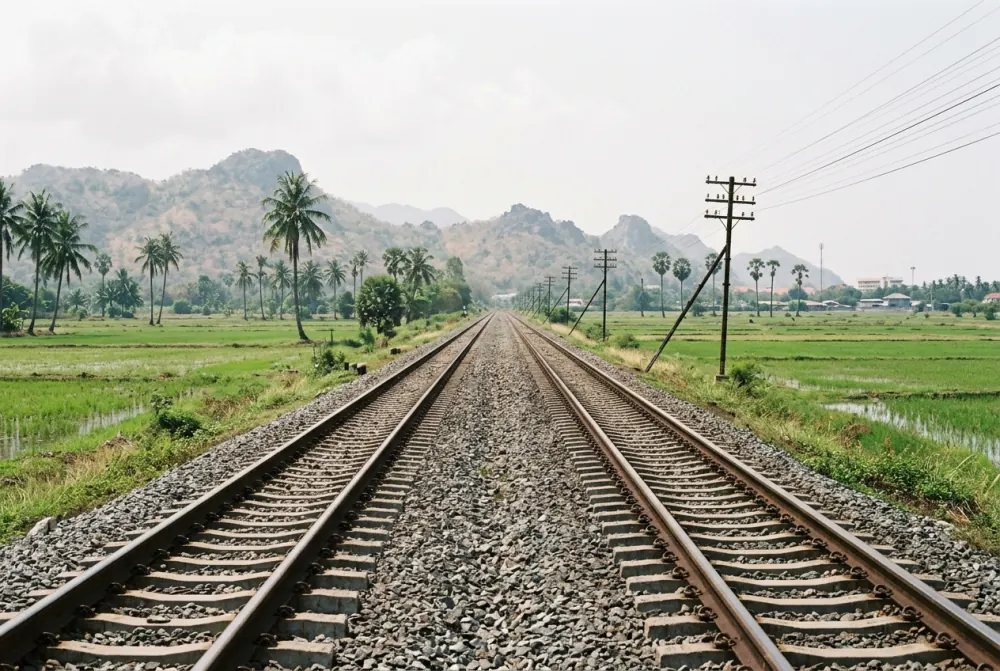
The train is the better journey on a timetable that rarely fits
The train from Bangkok to Hua Hin is a genuinely good three hours, and for most travellers it is at the wrong time of day.
Trains leave from Krung Thep Aphiwat Central Terminal (Bang Sue Grand Station) in Chatuchak, north of the centre — not from the old Hua Lamphong station, where a lot of outdated advice still sends people. The line is 229 km and the fastest service covers it in 3 hours 1 minute.
The problem is the shape of the timetable: one good morning departure, then a six-hour hole, then everything stacked into the late afternoon and evening.
| Train | Departs Krung Thep Aphiwat | Arrives Hua Hin |
|---|---|---|
| #43 Special Express DRC | 07:30 | 10:31 |
| #171 Rapid | 15:10 | 18:44 |
| #37 / #45 Special Express | 16:10 | 19:45 |
| #31 Special Express | 16:50 | 20:20 |
| #169 Rapid | 17:30 | 21:20 |
| #83 Express | 18:50 | 22:29 |
| #85 Express | 19:50 | 23:42 |
| #173 Rapid | 20:10 | 00:05 |
| #167 Rapid | 20:30 | 00:18 |
| #39 / #41 Special Express DRC | 22:50 | 02:04 |
The 07:30 is the one worth building a plan around. It arrives at 10:31 in daylight, it runs past salt flats and coconut plantations instead of a construction site, and it sets you down in the middle of town rather than on a highway. Everything after it arrives in the dark, and three services arrive at or after midnight, which is a poor way to start a weekend.
Going the other way, two afternoon departures do the work:
| Train | Departs Hua Hin | Arrives Bangkok |
|---|---|---|
| #40 Special Express | 14:36 | Krung Thep Aphiwat, 18:05 |
| #912 | 16:38 | Hua Lamphong, 21:40 |
They finish at different stations on opposite sides of the city, so check which one suits your onward plan before you buy. The 14:36 is the last departure that puts you back in Bangkok at a useful hour, and even that lands you crossing the city in the evening rush with luggage — it is not a connection to build an international flight on.
Reliability is the other half of the picture. The State Railway publishes no punctuality statistics for this line and none could be found, so the three hours is a timetable rather than a forecast. What can be said is that the southern line is now double-tracked as far as Prachuap Khiri Khan, which has made it materially better than a decade ago, and that delays accumulate through the day — the morning departure is the most dependable and the late-evening ones the least. A train booked into Hua Hin at 00:18 can comfortably become a 01:00 arrival, with no taxi rank worth the name waiting for it.
If you are booked on one of the late services, arrange the last two kilometres before you board, not on the platform. Ask the hotel whether reception is staffed overnight and whether it will send a car; if not, book a pickup against the train number the same way you would against a flight number. A station pickup is not one of the fixed fares in this chapter — those cover the Bangkok and Pattaya runs — so ask for the total when you arrange it. Opening a ride-hailing app on the forecourt at one in the morning is not a plan.
Fares are low. Roughly 44–94 THB in third class, about 150–330 THB for a second-class air-conditioned seat, around 620 THB for a sleeper berth bought at the station and about 720 THB for the same berth through an online agent. Slower Ordinary services also survive from Hua Lamphong (#261, 09:20–13:50) and Thon Buri (#255, 07:20–11:45, and #251, 13:10–17:30), taking four and a half hours or so for the cheapest fares available.
Trains use Hua Hin's elevated station, opened in December 2023. The much-photographed old timber station still stands about twenty metres away — Chapter 1 explains what it is and why it is the one sight that makes sense of the town.
With buses and minivans, the terminal matters more than the operator
Which company you travel with barely changes the journey. Which Bangkok terminal you leave from decides whether the trip is straightforward or a chore, because reaching a terminal can take a quarter of the total travel time.
- Sai Tai Mai (Southern Bus Terminal), Taling Chan. The main departure point and the widest choice. Pran Tour runs every 30 minutes from 05:00 to 22:00; the state Transport Co. runs hourly from 06:00 to 21:00. Fares are roughly 180–220 THB, with VIP coaches from around 490 THB through online agents, and the run is about 3.5 hours. Minivans leave from here too, roughly every 30 minutes, 180–300 THB. The catch is the terminal: it is west of the river and awkward to reach from most central hotels.
- Ekkamai, on Sukhumvit. The most convenient departure for anyone staying along the Sukhumvit corridor, because it is at Ekkamai BTS. Nor Neane Transport runs roughly hourly from 05:00 to 19:00, around 291 THB, about 4 hours. It arrives at the Soi 51 minivan station, roughly 1.7 km north of the railway station.
- Mo Chit 2, north Bangkok. JKP Mochit runs five fixed departures — 06:30, 10:00, 14:00, 16:00 and 18:00 — at around 308 THB, about 4 hours. Worth it only if you are already in the north of the city.
- Suvarnabhumi Airport direct. Roong Reuang Coach runs from Level 1 by Exit 8 straight to Hua Hin bus station, about 4 hours, around 478 THB, on 24-seat VIP coaches with a toilet. There are about 13 services a day, first departures from around 06:30. This is the only direct public link from an airport to Hua Hin, and it is the best-value option for a solo traveller landing at BKK in daylight. No equivalent service from Don Mueang could be found.
- Khao San Road tourist minibuses. Several operators, roughly 449–1,050 THB depending on the service level and departure time. Convenient if you are staying there, priced accordingly.
Two things apply whichever you choose. Buses and minivans sit in exactly the same Rama II traffic as everything else, so a timetabled 3.5 hours is a good-day figure and a Friday-afternoon departure will not hold it. And they set you down at a terminal rather than a hotel: Hua Hin bus station, the Soi 51 van station and the Khao San operators' drop-off points are scattered across town, so you finish the trip in a tuk-tuk or a Grab. Chapter 7 covers what local transport costs once you are here, and it is worth reading before you assume the last kilometre is trivial. Most services stop at Cha-Am on the way, which adds a few minutes and is useful if that is where you are staying.
The Pattaya ferry is not running, and has not since March 2020
If you are coming from Pattaya, you are driving. The catamaran across the Gulf no longer exists, whatever the search results say.
The route launched in 2017 and the idea was sound: Bali Hai Pier in Pattaya to the terminal near Khao Takiab in about 1 hour 40 minutes, on a catamaran carrying 150 passengers or a larger vessel carrying 262, cutting out the entire drive around the head of the Gulf. It would save roughly three hours against the road today. It was suspended in March 2020 when passenger numbers collapsed, the sole operator Royal Passenger Liner asked to cancel its contract, and Pattaya's mayor confirmed in August 2021 that there was no plan to appoint a replacement. Nothing has run since.
The Hua Hin terminal near Khao Takiab is dormant rather than demolished. The Marine Department has done basic maintenance on the docking platforms and pilings, and there is recurring talk of a "Blue Highway" network taking in Hua Hin to Pattaya, Hua Hin to Suvarnabhumi and a seasonal Hua Hin to Koh Samui run. No operator has been appointed, no contract signed and no restart date announced. It may come back. Plan as though it will not.
By road it is about 325 km around the top of the Gulf on Bangkok's ring roads, after which you inherit every Rama II problem described above. Scheduled buses and minivans are timetabled at around five and a half hours and cost roughly 450–600 THB per person. A private car takes four and a half to five hours and costs 3,000 THB for a sedan, 3,300 for an SUV or 3,800 for a van, one way, tolls included.
Frequently asked questions
How long does it really take to get from Bangkok airport to Hua Hin?
Three to three and a half hours by car from Suvarnabhumi, and the same or a little more from Don Mueang because you cross the whole city first. On a Friday afternoon, a Sunday evening or a public holiday weekend, budget four and a half to five hours. Immigration and baggage sit on top of that — the drive clock only starts when you reach the vehicle.
Is the train or a private car better?
They do different jobs. The 07:30 train is the pleasant option for a few hundred baht, but it is the only departure arriving in daylight and the next one is not until 15:10. A car leaves when you land, goes to your hotel door and carries the luggage. If you are arriving on a flight, the train timetable will rarely line up with it; if you are already in Bangkok with a free morning, the train is the nicer three hours.
Is the Rama II construction finished?
Partly. The 25 km elevated M82 motorway over the worst section opened fully on 28 August 2026 and stays toll-free until around 2029. The surface roadworks beneath it and the parallel Rama III expressway are unfinished and have been pushed back to mid-2027. Journeys should improve, but no one has measured by how much yet, so keep the same time buffers this season.
Does the Pattaya to Hua Hin ferry still run?
No. It was suspended in March 2020, the operator cancelled its contract, and Pattaya's mayor confirmed in August 2021 that the service had ended. Nothing has replaced it, and the terminal near Khao Takiab sits maintained but unused. Booking sites still list the crossing, which is why the question keeps coming up. By road, allow four and a half to five hours.
Can I fly from Bangkok to Hua Hin?
No. Hua Hin Airport has one scheduled route, to Chiang Mai with Thai AirAsia, at roughly seven flights a week. There has been no scheduled Bangkok service for years and there is little case for one: the flight would be about twenty minutes and the transfers at both ends would consume any time saved.
What time should I leave Hua Hin to catch a flight home?
For a 21:00 departure from Suvarnabhumi, leave around 14:30 on a weekday and around 13:30 on a Sunday. For an early morning flight, either travel in the small hours when the roads are clear or take an evening transfer and stay near the airport. The northbound Sunday afternoon crawl is the one that wrecks schedules, and it is entirely predictable.
Keep reading
- Arriving on a flight, or heading north again on a Sunday? Check transfer options and fixed fares — the prices on this page are one way, per vehicle, tolls included, and the same in either direction.
Last updated: 2026-08-29. Route timing and road notes come from Smile Taxi Service drivers who run Bangkok-Hua Hin transfers daily.