
Hua Hin Travel Guide · Chapter 3 of 8
Hua Hin's Beaches, from Town to Pranburi
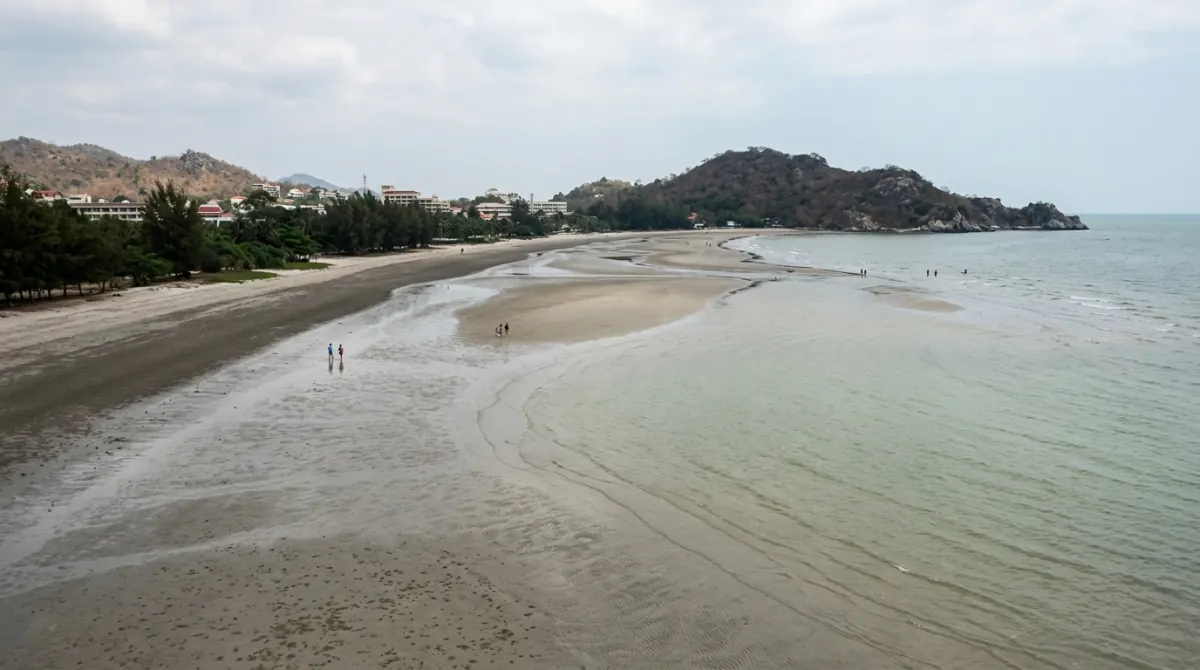
Hua Hin's town beach is long, flat, shallow and gentle with small children, and the water is green-brown rather than blue — Gulf sediment stirred by wind and tide, not pollution, on the available evidence. It is a beach for walking on more than swimming in. The clear water lies south of town: Sai Noi, Khao Kalok, Sam Roi Yot.
At a glance
| Town beach | Roughly 5–7 km, from the fishing pier south to Khao Takiab |
| Water | Warm, shallow, sediment-heavy green-brown. No evidence of a water-quality problem, and no site-level data either way |
| Sand | Fine, pale, firm underfoot, cleaned daily |
| Tide | Diurnal — one main high and one main low a day. Beach width changes dramatically between them |
| Clearest water within 30 minutes of town | Sai Noi, about 18 minutes south |
| Best beaches on this coast | Pranburi, Khao Kalok and Sam Roi Yot, 30–60 km south |
| Distances | Khao Takiab 6–7 km south · Suan Son Pradipat 7–9 km south · Pranburi 30 km south · Cha-Am 25 km north |
| Lounger and umbrella | About 50 THB (approx. USD 1.50) in town; around 20 THB at Suan Son; 30–50 THB at Cha-Am |
| Horse ride | Quoted anywhere between 200 and 1,000 THB (approx. USD 6–30) by length and operator. There is no fixed tariff |
| Beach massage | Around 300 THB (approx. USD 9) for 30 minutes; cheaper in the shops one street back |
| Jellyfish months | Reported August to December, worst after heavy rain |
| Red-flag season | Northeast monsoon, from about mid-October. Where flags fly, swimming is prohibited |
| Lifeguards | None on patrol. Flags and signs only |
| Best swimming months | The dry stretch, December to March. Red flags can fly from about mid-October and jellyfish are reported into December, so read the flags whatever the month |
The town beach is for walking, and the water will not look like the photographs
Start with the thing the marketing photographs get wrong, because it decides whether you will be happy here.
Hua Hin's water is not blue. It runs from pale green to milky brown depending on the tide, the wind and how recently it rained. This is a shallow, silty corner of the Gulf on the mainland shore; the seabed is fine sand, the shelf runs out almost flat for a long way, and every wave and every passing boat lifts sediment into the water column. After a heavy rain the colour goes distinctly brown for a day or two. Visitors who arrive from Krabi or the Andaman islands are consistently disappointed, and they are not being unfair.
What that colour is not, on the available evidence, is dirt. Thailand's Pollution Control Department monitors coastal water nationally and rates the great majority of sites Fair or Good, and Prachuap Khiri Khan has a strong provincial reputation — though it is worth knowing that when the environment ministry named the country's cleanest seawater in its 2021 audit, the province's entries were Ban Krut and Ao Manao, both more than 150 km further south, and Hua Hin itself was not among them. We could not find a published, site-level water quality figure for Hua Hin town beach specifically, and readers should treat any guide that quotes one as unsourced.
Long-term residents make one distinction that recurs often enough to be worth passing on: the water is generally reported as murkier at the downtown end, near the hotels and the old guesthouse piers, and cleaner as you walk south towards Khao Takiab. That is anecdotal rather than measured, but it matches the geography — the town end has the storm drains, the fishing harbour and the least water movement.
Now the case for the beach, which is real:
- The sand is good. Fine, pale and firm enough to walk, run or cycle on at low tide. The municipality cleans it, and the standard of upkeep is higher than the size of the town would suggest.
- It is long and continuous. Roughly 5 to 7 kilometres from the fishing pier at the north end down to the Khao Takiab headland — published figures differ, largely because sources start and finish the measurement in different places. Walking it end to end and back is a two- to three-hour outing, and a lot of people here structure their day around it.
- It shelves very gently. You can wade a long way out and still be standing. For toddlers and non-swimmers this is the whole point, and it is why Bangkok parents choose Hua Hin over places with better-looking water.
- Nothing needs to be negotiated. Access is free and public, through the sois that run down from Naretdamri Road and the beach roads. There is no beach club fence to get past.
The coast faces east, so the sun comes up out of the sea and the best hour of the day here is before breakfast. What the beach cannot do is snorkelling or underwater photography, for the same reason the water is the colour it is.
Walk south and the beach improves, and every quiet stretch is in that direction
The single most useful thing to know about this coastline is that it gets better going south and does not get better going north. That runs against the way the beaches are usually listed, and it is worth correcting: Suan Son Pradipat, the beach most often filed under "quiet northern stretch", is south of Hua Hin, not north.
Khao Takiab beach, 6 to 7 kilometres south and 10 to 15 minutes by road, is the town beach's better half. The headland splits it in two. The northern side, running down from the Bluport mall towards the hill, keeps more sand at high tide than the town beach does and is markedly calmer. The southern side runs on towards the pine-shaded stretch, backed by casuarinas and popular with Thai visitors. Fishing boats work off both sides, which is where a good deal of the town's seafood comes from. The temple on the headland, the standing Buddha and the resident macaques, which bite, are covered in Temples, Palaces and Viewpoints Around Hua Hin — read the monkey warning there before you walk up.
Hua Don, at the southern foot of the headland where the green songthaew route ends, is the fishing-village end of the same bay: a wide sandbar, calm water, and a run of unpretentious seafood restaurants. Loungers here are packed in tightly enough that it can feel crowded even when the beach is not.
Suan Son Pradipat is the outlier and the best-value beach day near town. It sits 7 to 9 kilometres south — some listings say 16 km, which appears to measure from a different point — on land belonging to the Royal Thai Army, and it is run by the army's Infantry Centre. It is open to everyone. A continuous line of casuarina pines shades the whole stretch, which no other beach near town does. There are food courts and restaurants at local prices, a jogging track, showers and toilets, guest rooms, and a Bryde's whale skeleton on display at the entrance. Deckchairs are hired out for about 20 THB (approx. USD 0.60), though that figure rests on one undated listing. There are no jet skis and no banana boats, which is a deliberate policy of the army's, not an accident. Weekdays are quiet; weekends and Thai public holidays fill up, helped by an excursion train that runs down from Bangkok. The Infantry Centre's recreation office at the entrance runs the beach and the guest rooms: ask there for the current chair rate and whether parking or entry is being charged, since we found no published tariff for either.
Khao Tao and Sai Noi, about 18 minutes south, are where the water finally clears. Sai Noi is a small cove of around 360 metres closed at each end by rock, just south of the temple at Khao Tao. It has the whitest sand and the clearest water within easy reach of town, it drops off more quickly than the town beach so you can actually swim rather than wade, and it has a handful of beach-shack restaurants and a small resort behind it. It has become steadily busier and it is not a secret any more, but on a weekday morning it is still the best short drive on this coast. Loungers are reported at about 100 THB (approx. USD 3) and beach massage at around 300 THB.
The best beaches near Hua Hin are not in Hua Hin
Thirty kilometres south, the coast stops being a resort town's frontage and starts being a coastline.
Pranburi and Pak Nam Pran run for several kilometres of open, low-density sand about 30 minutes from town. The water is cleaner, the beach is wider, the buildings behind it are boutique and design-led rather than block resorts, and the fishing fleet still works out of the river mouth. This is where a large share of Hua Hin's repeat visitors end up staying once they have done the town once. The trade-off: there is no walkable dinner strip, no market within strolling distance and no evening to wander into. You eat where you are staying, or you drive.
Pranburi Forest Park, at the river mouth, has a raised wooden boardwalk of about a kilometre through mangrove. Entry is free, published hours are roughly 06:00 to 18:00, and boat trips through the channels are quoted at around 450 THB (approx. USD 13) for a small group. It takes an hour, it is shaded, and it is the one thing on this stretch that works well in the middle of a hot afternoon.
Khao Kalok, about 40 minutes south at the foot of the headland the name refers to, is wide, open and largely empty even in high season. The water here is among the clearest on this part of the coast, particularly early, before the afternoon wind gets up. There are simple beach restaurants that will bring food to your chair.
Dolphin Bay and Sam Roi Yot, 50 to 60 minutes south, are the end of the improvement curve: a long, flat, shell-strewn bay that stays shallow a long way out, with clear warm water, hermit crabs and starfish in the shallows, and enough space that a busy day still looks empty. It is family territory rather than scenery territory. Laem Sala and Sam Phraya beaches sit inside Khao Sam Roi Yot National Park, backed by casuarinas and limestone, and require the park ticket — the fee and the practicalities of the park are in Chapter 5, along with Phraya Nakhon Cave, which is the reason most people make this drive in the first place.
If beach quality is the thing you care about most, base yourself in Pranburi and treat Hua Hin as the place you drive to for dinner and markets, rather than the other way round.
How you move between them is the part to settle before you set off. A hire car or a motorbike does it, and so does a car with a driver taken for the day. Ride-hailing will bring you out, but the car then has to be summoned back from a stretch of coast with very little supply, and on a weekday the wait can cost you the afternoon. Chapter 8 puts these beaches into a single day.
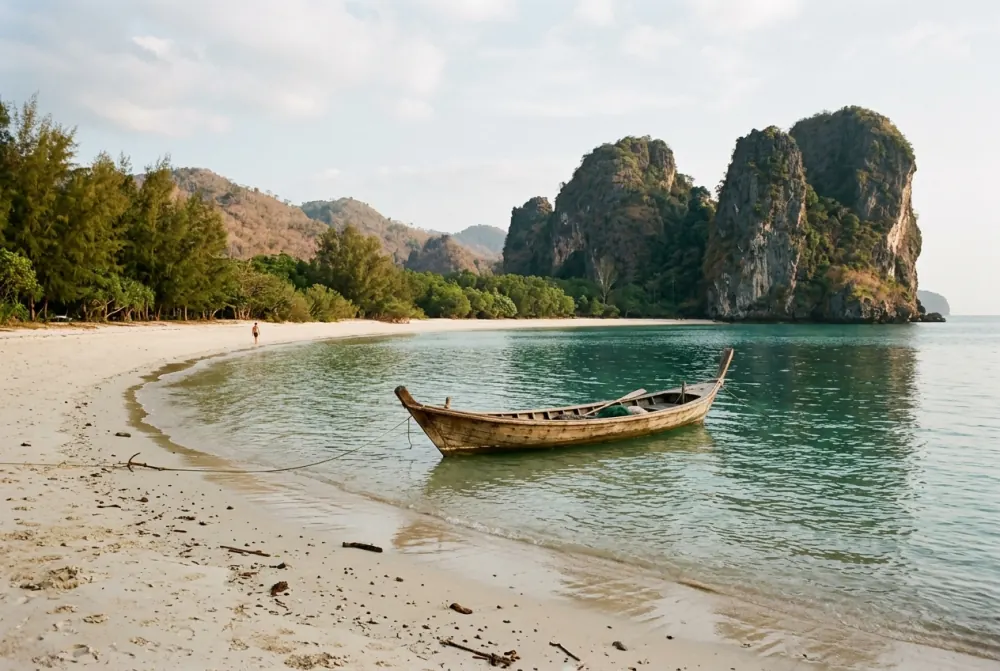
Cha-Am is cheaper, more Thai and a different kind of day out
Twenty-five kilometres north, 25 to 30 minutes by car, in a different province, Cha-Am is not a lesser Hua Hin. It is a different product.
The beach is roughly four to six kilometres of wide, gently shelving sand backed by casuarinas, and the defining feature is the deckchairs: hundreds of them, set out in rows under the trees, hired with a table and umbrella for something in the region of 30 to 50 THB. You sit, food and drink come to you, and you stay all day. That is the format, and Thai visitors love it. From Saturday morning to Sunday afternoon the coaches arrive from Bangkok and the beach fills with groups eating seafood and drinking around the tables. Midweek it is close to empty.
Reviews of the water are, if anything, slightly better than those for central Hua Hin — several recent ones describe it as clean, warm and gently sloping — but it is the same Gulf, with the same sediment, and it can be murkier after rain.
Where Cha-Am is weaker is everything behind the sand. Foreign visitors are a small minority, restaurants are more limited and more spread out, and the strip of themed attractions along the Phetkasem Road between the two towns has hollowed out since 2020, Santorini Park included, which has been shut for years. Chapter 6 sorts which of them still work and which are open in name only. Cha-Am rewards a beach day and a seafood lunch. It does not reward a walk-around evening.
One tide a day, red flags from mid-October, and jellyfish from August
The tide here is diurnal. Unlike most coastlines, Hua Hin gets one main high and one main low in a day rather than two of each, and the swing is large — commonly one to two and a half metres between them. The practical effect is that the beach changes shape completely between morning and afternoon. At low tide you get a wide, hard, walkable expanse and a long wade to get out of your depth. At high tide, in some sections, the water comes right up to the wall and the beach effectively disappears. Around the full and new moon the extremes are greater still. Check a tide table for the day rather than assuming the beach will look the way it did yesterday, and if you have small children, plan the beach session around low and mid tide.
From about mid-October the northeast monsoon arrives, and with it the red flags. This is a real prohibition rather than advisory decoration: in October 2025 the municipality ordered red flags raised along the beach near the Chao Mae Thapthim shrine — one of the busiest swimming areas — with swimming banned outright while conditions lasted, and similar orders have been issued in previous years. There is no lifeguard patrol on Hua Hin beach. The flag and the sign are the entire safety system, so treat them as the instruction they are, and stay out of the water during and immediately after heavy rain.
Jellyfish are a genuine seasonal issue and the months are wider than most guides admit. Local reporting names August to December as the period of increased jellyfish on Hua Hin and neighbouring beaches, while other accounts put the worst stretch at June to October; both agree that the risk rises during the monsoon and spikes after rain. Four types show up here: leatherback and cabbage jellyfish, which are largely harmless; fire jellyfish, whose sting burns; and box jellyfish, which are dangerous. The Tourism Authority of Thailand lists the Hua Hin and Cha-Am coast among the areas with documented box jellyfish sightings. Stings remain rare, and this is not a reason to stay out of the sea in February — it is a reason to look before you swim in September.
On seaweed: drifting weed does wash up here, particularly after storms, but we could not find any documented seasonal weed bloom for Hua Hin of the kind that affects some other Thai coasts. Guides that give you a "weed season" with months attached are not citing anything we could trace. What genuinely changes the water month to month is rain and wind, not algae.
That is the pattern to plan around. The water is at its brownest through the wet half of the year and for a day or two after any heavy fall, and at its clearest in the dry stretch from December to March, when the sea is also at its flattest. November is cool but not yet dry — the tail of the wet season, not the start of the dry one, which is why settled swimming here begins later than the cool weather does. The month-by-month rainfall and temperature figures, and what they can and cannot be used for, are in Chapter 7.
Horses, chairs and vendors: what is actually on the sand, and what it costs
Horse riding is Hua Hin's signature beach activity and it is not what most visitors picture. Around sixty horses work the beach, gathering near the main beach entrance at the northern end. What you get is not a trail ride: a handler leads or accompanies the horse at walking pace along the sand for a set number of minutes, helps you mount, and takes the photograph. Children ride led. It lasts as long as you paid for.
Prices are not fixed and the published figures disagree sharply. One long-standing local listing gives 200 THB for 15 minutes, 300 THB for 30 minutes and 600 THB for an hour; other recent reports give 400 THB for 20 minutes, 500 THB for 30 and 1,000 THB for an hour. Expect to be quoted at the top of that range and to negotiate. Agree the price and the duration before you get on.
The welfare question is unresolved. The horses are registered and numbered, and the municipality has taken action about them — but the action was about tourist-facing conduct rather than animal welfare. After complaints in early 2021, officials met 61 operators and required them to dress properly, display name tags on the horses, join beach-cleaning duties and stop leaving dung in front of hotels; the town also established ten rest stops for the horses with a supervisor at each. That is a real improvement on nothing. It is not a welfare inspection regime, and we could find no evidence that one exists.
Against that, experienced riders reporting from Hua Hin raise the same points repeatedly: long shifts in full sun, ill-fitting saddles, harsh bits, stallions worked in close quarters with tourists, and handlers hitting horses to move them on. These are visitor accounts rather than veterinary findings, and the condition of individual animals varies a great deal from operator to operator.
What that leaves you with is a judgement rather than a rule. If you want to ride, look at the specific horse in front of you before you pay — body condition, sores under the tack, whether it is standing calmly — ride early or late rather than in the middle of the afternoon, and be willing to walk away from a particular animal or handler. There are also stable-based riding operations inland from the beach, which reviewers rate better on care than the beach trade, though we have not verified their standards independently.
Chairs, umbrellas and everything else that comes to you:
- Loungers and umbrellas are set out daily at the public beach entrances in town, generally around 50 THB for a lounger with an umbrella, and the attendant will bring a table. Suan Son is cheaper at about 20 THB, Sai Noi is reported at around 100 THB, and Cha-Am works on a per-person, all-day basis at roughly 30 to 50 THB. These figures come from visitor reports rather than a published tariff, so ask first — it takes one question and removes the only argument likely to arise.
- Food comes to you. Carts and walking vendors work the sand with grilled squid, roti, sweetcorn, fresh fruit, ice cream and cold drinks. Prices are low and generally not aggressive, though they are still higher than the same item bought one street back.
- Beach massage is a licensed trade here rather than an informal one. Since a municipal clean-up, masseurs and hawkers wear colour-coded shirts with name tags and carry licences, and the number permitted to work the beach was capped. Expect around 300 THB for 30 minutes on the sand. A shop one street inland will usually be cheaper for a longer treatment.
- Jet skis, banana boats and parasailing operate from the central stretch. Since January 2024 the municipality has required water-sports operators to register, marked out activity zones, and imposed equipment checks, with a separate kitesurfing zone limited to four riders at a time. As anywhere in Thailand, photograph the equipment before you take it out and agree the price in advance. Kitesurfing has its own season and its own economics, and those are in Chapter 6.
Frequently asked questions
Is Hua Hin beach nice?
It is a good beach and a poor postcard. The sand is fine, pale, clean and long enough to walk for two hours, and the water is warm, shallow and gently shelving. It is also green-brown rather than blue, because this is a shallow silty corner of the Gulf. If you want a beach to walk on, run on and let children paddle in, it is excellent. If you want clear water, drive south.
Can you swim at Hua Hin beach?
Yes, for most of the year. The water is shallow, warm and gently shelving, and the sea is at its flattest through the dry stretch from December to March. There is no evidence of a water-quality problem here, and no site-level data either way. Two things override that: red flags, which appear with the northeast monsoon from about mid-October and mean swimming is prohibited rather than discouraged, and heavy rain, after which it is better to stay out. There are no lifeguards.
Which beach is best near Hua Hin?
For water quality within a short drive, Sai Noi at Khao Tao, about 18 minutes south — a small cove with the clearest water and a proper drop-off. For a full day, Suan Son Pradipat, the army beach 7 to 9 kilometres south, shaded by pines with cheap food and no jet skis. For genuinely good coastline, Pranburi, Khao Kalok and Sam Roi Yot, 30 to 60 kilometres south.
Are there jellyfish at Hua Hin?
Yes, seasonally. Local reporting names August to December as the period of increased jellyfish along this coast, with the risk highest during and after rain; other accounts put the worst months at June to October. Most are harmless, but fire jellyfish sting badly and box jellyfish have been recorded here. Treat any sting with vinegar for 30 seconds, never fresh water, and call 1669 if it is serious.
How much does horse riding on Hua Hin beach cost?
There is no set tariff and quotes vary widely — published figures run from 200 THB for 15 minutes up to 1,000 THB for an hour, so agree the price and the duration before you mount. Around sixty horses work the northern end of the beach. Welfare standards vary between operators, so look at the individual animal's condition first and be prepared to decline.
Is Cha-Am beach better than Hua Hin?
Different rather than better. Cha-Am is wider, cheaper, shaded by casuarinas and organised around all-day deckchair hire with food brought to you — quiet midweek, busy with Thai visitors at weekends. The water is much the same Gulf water. Hua Hin wins on restaurants, markets and things to do after dark; Cha-Am wins on cost and on the beach-day format itself.
Keep reading
- Month-by-month weather, the green songthaew's fares and hours, and which base suits which beach: Eating, Sleeping and Practical Hua Hin
- Sai Noi, Khao Kalok and Sam Roi Yot in one day, with the driving times: Hua Hin Itineraries: Weekend, Three Days and a Day Trip
Last updated: 2026-08-29.